by Juhi Varma
A ceder elm sapling planted outside the Fort Bend County Courthouse on July 2 serves as more than a new addition to the courthouse grounds. It is a living reminder of the ideals that inspired the American Revolution 250 years ago.
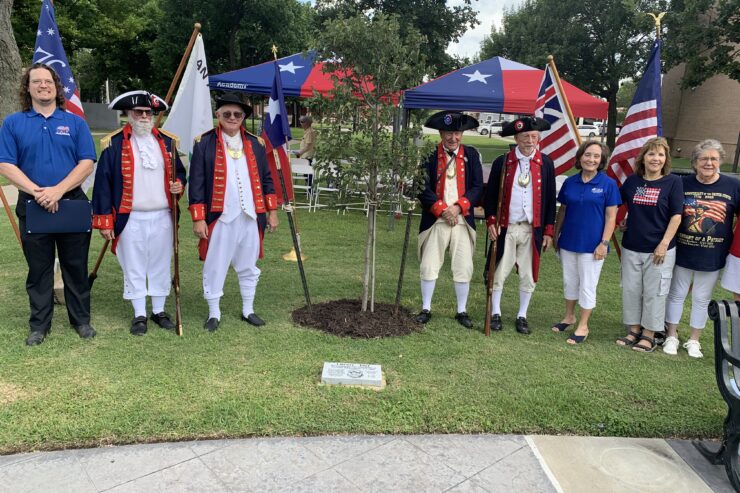
Area residents and community leaders joined representatives from the Alexander Hodge Chapter of the Sons of the American Revolution (SAR) for the planting, and the unveiling of a 250th anniversary granite marker bearing the name of Alexander Hodge. A proclamation was presented by Fort Bend County Judge Daniel Wong.
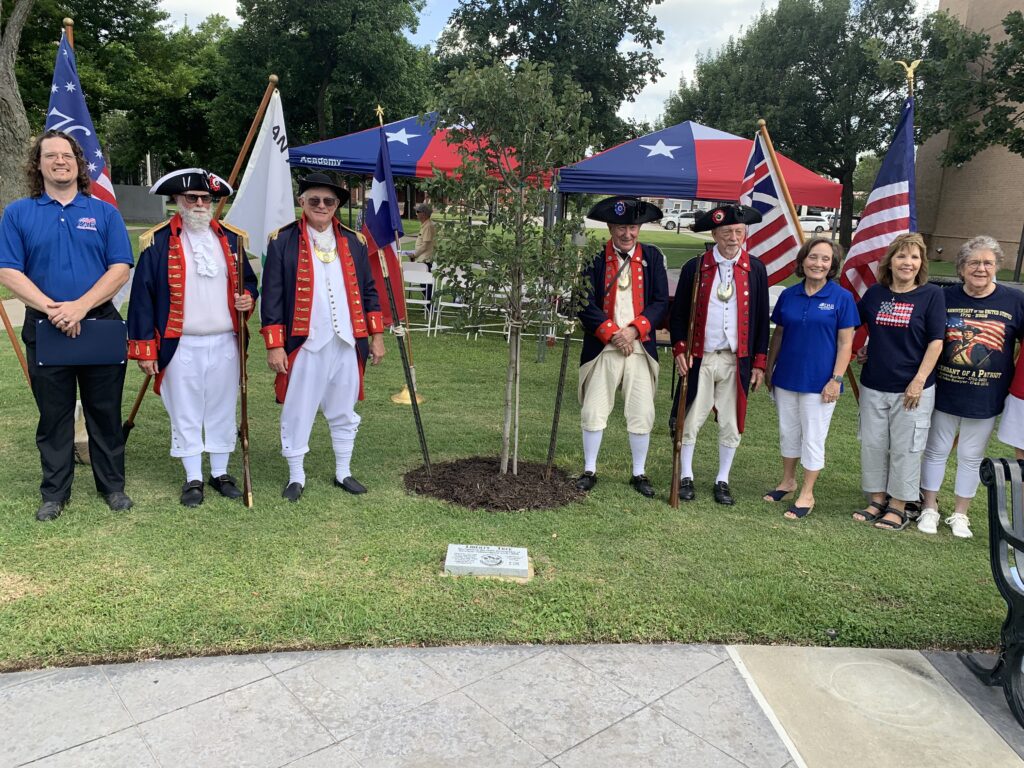
The ceremony at 401 Jackson Street included the dedication of the Liberty Tree and the unveiling of a 250th anniversary granite marker bearing the name of Alexander Hodge
The original Liberty Tree on the Boston Common in Boston, Massachusetts, became one of the most recognizable symbols of colonial resistance in the years leading up to the Revolutionary War. It served as a meeting place for colonists—under this tree they discussed British rule, organized protests and advocated for independence. Hoping to crush their movement and their spirit, British soldiers cut down the tree in August 1775.
“The British became so incensed about it that they cut it down, and so this symbol that had been there for at that point hundreds of years as a meeting point was cut down,” said Rick Guiffre from SAR. “But you can cut down a tree, but you can’t cut down an idea. So, the colonists continued to meet there to discuss their ideas.
To commemorate the nation’s semi quincentennial, Sons of the American Revolution chapters across the country have been planting Liberty Trees in their communities. Because the original tree was an elm, organizers selected a cedar elm—a species native to Texas—that is better suited to Fort Bend County’s climate.
“Our member Josh Evans spent a great deal of time researching which native species would be the most appropriate,” Guiffre said.
What is SAR?
There are Sons of the American Revolution (SAR) chapters in all 50 states. Alexander Hodge is the Sugar Land chapter’s namesake.
SAR members must prove they are direct descendants of someone who supported the American Revolution, and members often dress up in historical uniforms for parades and educational events.
“I’m a descendant of Miram Landry, who fought under Bernardo Galvez in the American Revolution,” said Guiffre. “All of us have a direct lineal relationship to some revolutionary, usually soldiers.”
Alexander Hodge has a unique place in Texas history. Guiffre said Hodge fought in the American Revolution and later became one of Stephen F. Austin’s Old Three Hundred settlers in Texas. He also participated in the Texas Revolution.
Hodge eventually settled in what is now Fort Bend County, receiving a land grant between the Brazos River and Oyster Creek, an area that today includes parts of the Sienna subdivision.
“Alexander Hodge fought in two revolutions,” Guiffre said. “He fought for American independence and later helped shape the Republic of Texas. That connection makes Fort Bend County an especially meaningful place for this tree.”
Photos by Rick Guiffre