MUNICIPAL HISTORY | 1946–2026
The Mayors of
Katy, Texas
Eight decades of local leadership, growth, public service, and civic identity
A researched account of all seventeen mayors—from C. L. Baird, the first mayor after incorporation, to current Mayor William H. “Dusty” Thiele.
| CURRENT THROUGH JULY 20, 2026
Includes historical context, complete mayoral timeline, biographical profiles, 2025 election results, and source notes. |
LONG-FORM ARTICLE
Prepared July 2026
FRONT MATTER
Reader’s Guide
This document is written as a publication-ready historical article. Citation numbers in superscript correspond to the source notes at the end. The narrative distinguishes confirmed biographical facts from broader historical context, especially for early mayors whose public records are limited.
| KATY MUNICIPAL HISTORY AT A GLANCE
Incorporated: 1945 First municipal administration: 1946 Number of mayors through July 2026: 17 Current mayor: William H. “Dusty” Thiele 2025 estimated population, city proper: 28,373 Government: Home-rule city; mayor elected at large |
Contents
01 Executive Summary
02 Scope, Terminology, and Sources
03 Complete Timeline of Katy Mayors
04 Katy Before Its Mayors: Prairie, Railroad, Rice, and Gas
05 What the Mayor’s Office Means in Katy
06 The Founding Mayors, 1946–1971
07 Charter Government and Institutional Growth, 1971–1995
08 Commercial Expansion and Regional Visibility, 1995–2013
09 Modern Transitions, 2013–2022
10 Current Mayor William H. “Dusty” Thiele, 2022–Present
11 Eight Themes Across Seventeen Mayors
12 Conclusion: A Continuous Civic Project
13 Source Notes and References
REFERENCE
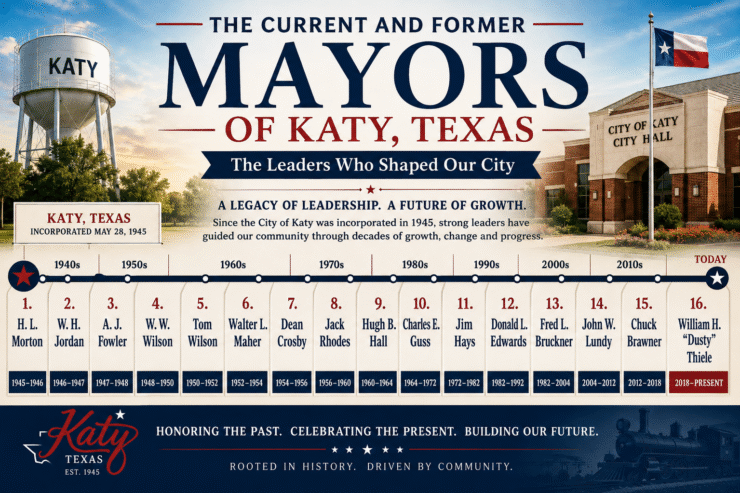
Complete Timeline of Katy Mayors
The following chronology uses the sequence published when Dusty Thiele became Katy’s seventeenth mayor in 2022. The short notes identify documented context without assigning unsupported projects to officeholders. [5]
| No. | Mayor | Term | Historical note |
| 1 | C. L. Baird | 1946–1947 | First mayor after incorporation; helped establish the initial municipal government. |
| 2 | Arthur O. Miller | 1947–1963 | Sixteen-year tenure; businessman, early city secretary-treasurer, and later municipal judge. |
| 3 | J. E. Hudgens | 1963–1967 | Led during the city’s early transition from a small agricultural town toward metropolitan growth. |
| 4 | C. E. Freeman | 1967–1969 | Served as regional development and population growth accelerated around Houston. |
| 5 | M. E. Watts | 1969–1971 | Closed the first quarter-century of incorporated municipal government. |
| 6 | Dan Cox | 1971–1979 | Eight-year tenure during rapid population expansion and growing municipal service demands. |
| 7 | John G. Morrison | 1979–1983 | Known as Katy’s “charter mayor”; the Home Rule Charter was adopted in 1981. |
| 8 | John L. “Johnny” Nelson | 1983–1987 | Later served twenty years as city administrator and became closely identified with Katy’s development and heritage. |
| 9 | Ward A. Stanberry | 1988–1991 | Longtime council member and World War II veteran who brought decades of civic experience to the office. |
| 10 | J. W. “Skip” Conner | 1991–1995 | Emphasized fiscal management and recruited Johnny Nelson as city administrator. |
| 11 | M. H. “Hank” Schmidt | 1995–2001 | Mayor during the period associated with Katy Mills and major commercial expansion. |
| 12 | Doyle G. Callender | 2001–2007 | Promoted civic heritage and helped advance the development of Katy Heritage Park. |
| 13 | Donald “Don” Elder Jr. | 2007–2013 | Brought experience from education boards, business, city council, and long residence in Katy. |
| 14 | Fabol R. Hughes | 2013–2017 | Oversaw construction and dedication of the present City Hall amid annexation and development. |
| 15 | Charles A. “Chuck” Brawner | 2017–2019 | Led through Hurricane Harvey and a subsequent emphasis on drainage and flood-control projects. |
| 16 | William M. “Bill” Hastings | 2019–2022 | Former Katy police chief; first mayor elected to a three-year term under the revised cycle. |
| 17 | William H. “Dusty” Thiele | 2022–present | Downtown business owner and former appointee to council; elected in 2022 and reelected in 2025. |
Timeline note: published term labels may reflect election and swearing-in timing. “Skip Conner” follows the Katy Times spelling; a 2009 magazine retrospective used “Connor.”
ARTICLE
Executive Summary
The history of Katy, Texas, can be read through the work of seventeen mayors who have held office since the first municipal administration was organized in 1946. Their combined record follows a striking civic transformation. Katy began its incorporated life as a compact rice-farming and energy town with fewer than one thousand residents. It is now a fast-growing home-rule city in the western Houston metropolitan area, with an estimated 28,373 residents in the city proper as of July 1, 2025. The U.S. Census Bureau estimates that the population increased 29.7 percent from the 2020 population base to the 2025 estimate. [1][2][3]
That growth did not occur under one mayor or through one signature project. Katy’s development was cumulative. Early mayors created and stabilized the municipal organization. Later administrations expanded services, adopted a home-rule charter, professionalized city management, strengthened public safety, negotiated development, preserved historical resources, and responded to floods, drought, traffic, infrastructure pressure, and the demands of a larger tax base. Each mayor inherited decisions made before taking office, and most major accomplishments depended on cooperation among the mayor, city council, professional staff, regional agencies, residents, and private institutions.
The current mayor is William H. “Dusty” Thiele. He first took office on May 13, 2022, after being declared elected as an unopposed candidate. Voters returned him to office in the May 3, 2025 election, and the city’s official leadership pages continued to identify him as mayor in July 2026. Thiele’s public biography emphasizes business experience, service on city boards and council, customer service, public safety, economic development, mobility, and the preservation of Katy’s small-town identity. [4][18][19][20][21]
This article provides a complete chronological account of the current and past mayors, while separating documented biography from reasonable historical context. The surviving public record is detailed for recent administrations but limited for several early officeholders. Where an individual project cannot be reliably attributed to a mayor, the discussion focuses on the conditions of the term rather than assigning unsupported credit. That distinction is important: a useful local history should explain what is known, identify what remains uncertain, and avoid turning civic development into mythology.
Scope, Terminology, and Sources
In local conversation, “Katy” can refer either to the incorporated City of Katy or to a much larger suburban area that uses Katy mailing addresses and is served by Katy Independent School District. The distinction matters. The mayor governs the incorporated city through the authority provided by the City Charter and Texas law; the mayor is not the executive of the entire Greater Katy region. Much of the area’s population, development, roadway system, drainage infrastructure, and public services lies in Harris, Fort Bend, or Waller County jurisdictions outside the city limits.
The chronology in this article follows the mayoral list published when Dusty Thiele took office as Katy’s seventeenth mayor in 2022. That list identifies C. L. Baird as the first mayor and Thiele as the seventeenth. Contemporary and retrospective sources occasionally vary in spelling or in the calendar-year boundary assigned to a term. For example, the Katy Times list uses “Skip Conner,” while a 2009 magazine profile printed the surname as “Connor.” The Katy Times spelling is used here. Similarly, the published sequence places Johnny Nelson’s term in 1983–1987 and Ward Stanberry’s in 1988–1991. Such year labels often reflect election and swearing-in timing rather than a twelve-month absence from office. [5][7]
The main sources include the City of Katy’s official history, election records, mayoral biography and public message; the Handbook of Texas; U.S. Census Bureau data; a Katy ISD biography of Arthur O. Miller; and reporting from the Katy Times, Katy Magazine, and Community Impact. The source list at the end provides the titles and links. The article is current through July 20, 2026.
CHAPTER 1
Katy Before Its Mayors: Prairie, Railroad, Rice, and Gas
Katy’s municipal story begins long before incorporation. The prairie west of Houston was used by Indigenous peoples, including the Karankawa, and supported wildlife across a broad grassland environment. A nineteenth-century settlement known as Cane Island developed in the area by 1872. The name referred to Cane Island Creek and to the slightly raised ground that stood above portions of the surrounding prairie. The geography shaped the community’s identity: flat land, rich soil, seasonal water, and access routes would influence agriculture, drainage, transportation, and urban development for generations. [1]
Railroad access converted a rural settlement into a town site. The Missouri-Kansas-Texas Railroad reached the area in the 1890s, and promoters platted the town in 1895. A post office followed in 1896. The name “Katy” is generally associated with the railroad’s “K-T” abbreviation. The station linked farmers and merchants to regional markets, made shipment of agricultural products practical, and established the linear commercial pattern that remains visible around the historic center. The depot itself became part of Katy’s civic memory, eventually passing to city ownership in the twentieth century. [1][2]
The 1900 hurricane that devastated Galveston also damaged the young community of Katy, destroying many buildings. Residents rebuilt. Rice cultivation, introduced near the beginning of the twentieth century, became the defining local industry, supplemented by cotton and peanuts. Rice required capital, irrigation, storage, milling, labor, transport, and cooperation. As a result, the agricultural economy was not merely a landscape of fields; it was an institutional system that trained residents in collective action and tied local businesses to the railroad and to Houston markets. [1][2]
Energy development added a second economic foundation. A natural-gas field was discovered in 1934, and the field became important during World War II. A processing plant opened during the war years, strengthening Katy’s connection to the Gulf Coast energy economy. Agriculture remained culturally central, but gas production diversified employment and revenue. It also placed new demands on roads, land use, utilities, safety, and relations with companies operating across a rural jurisdictional landscape. [1][2]
Katy incorporated in 1945. The Handbook of Texas identifies C. L. Baird as the first mayor and Arthur O. Miller and H. E. Romack as members of the first council. Incorporation gave residents a legal structure for taxation, ordinances, contracts, streets, utilities, policing, fire protection, and land-related decisions. The new city was small—the 1950 census counted 849 residents—but it now had an institution capable of surviving changes in leadership and carrying decisions from one administration to the next. [2][3]
The population figures reveal the scale of the coming challenge. Katy grew from 849 residents in 1950 to 1,569 in 1960, 2,923 in 1970, 5,660 in 1980, 8,004 in 1990, 11,775 in 2000, 14,102 in 2010, and 21,894 in the 2020 census. These numbers describe the city proper, not the entire area identified with Katy. They show that every generation of municipal leadership faced a larger organization, a more valuable physical plant, and a more complicated relationship with surrounding development than the generation before it. [2][3]
CHAPTER 2
What the Mayor’s Office Means in Katy
Katy operates under a home-rule charter. The mayor is elected at large, meaning voters across the city choose the officeholder rather than voters in a single ward. The city’s 2022 election records state that the mayor serves a three-year term and must be a United States citizen, at least twenty-one years old, a qualified voter, and a city resident for at least twelve months before the election. The same record states that the mayor may not hold another public office. [4]
The current elected body consists of the mayor and five council members: two representing Ward A, two representing Ward B, and one elected at large. This structure combines neighborhood representation with citywide perspectives. The mayor supplies visible leadership, presides in the governing process, represents the city publicly, helps frame priorities, and works with council and staff. Yet the mayor does not act alone. Budgets, bonds, contracts, ordinances, appointments, annexations, and large capital projects require formal action, technical review, and often public participation.
The adoption of the Home Rule Charter in 1981 was a pivotal change because it gave Katy a locally designed governmental framework within the limits of state law. John G. Morrison became known as the “charter mayor” for his role in that period. Home rule did not eliminate regional dependence or political disagreement, but it gave a growing city a more durable structure for managing its own affairs. [7]
Professional administration also became increasingly important. As population, revenues, staffing, development review, emergency operations, and capital planning expanded, the city needed managers and department heads able to carry policy into daily operations. Johnny Nelson’s twenty years as city administrator, after having served as mayor, exemplified the connection between elected vision and professional execution. The arrangement also prevented municipal expertise from resetting after every election. [8]
Katy’s mayors have tended to arrive with practical local experience rather than national political profiles. Their backgrounds include agriculture, small business, banking, insurance, education governance, ministry, police, fire service, and city boards. This pattern reflects the work of municipal government. Residents judge a mayor less by ideology than by whether water flows, streets function, emergency services respond, drainage improves, permits are handled, taxes are understood, and development fits the community.
CHAPTER 3
The Founding Mayors, 1946–1971
The first five mayors served during Katy’s transition from newly incorporated town to established small city. Their period began with fewer than one thousand residents and ended with a 1970 population approaching three thousand. Public biographical material is uneven. Arthur O. Miller is well documented because of his long tenure and later educational namesake; the surviving accessible record for Baird, Hudgens, Freeman, and Watts is largely a sequence of names and dates. That imbalance should not be mistaken for a difference in importance. Early administrations built the routines on which later, better-documented projects depended. [3][5][6]
| ERA MARKERS
Population: 849 in 1950; 2,923 in 1970 Central task: Establishing municipal continuity and basic capacity Documented turning point: Arthur O. Miller’s sixteen-year tenure |
C. L. Baird 1946–1947
- L. Baird was Katy’s first mayor. His term followed the city’s 1945 incorporation and the organization of its first governing body. The Handbook of Texas identifies Arthur O. Miller and H. E. Romack as council members serving with him. The first administration’s fundamental achievement was institutional rather than architectural: it began converting an incorporated charter on paper into a working municipal government. [2]
A founding mayor must address basic questions that later residents take for granted. Who keeps records? How are ordinances adopted and published? Which roads and services fall within city responsibility? How are revenues collected and bills approved? How does the city coordinate with county government, schools, utilities, rail interests, landowners, and volunteer organizations? The accessible record does not attribute particular ordinances or projects to Baird, so those questions should be understood as the general work of the period rather than a list of personal accomplishments.
Baird served only about a year, but the brevity of the term does not reduce its historical status. By establishing a lawful succession, the first administration helped make the mayor’s office an enduring local institution. Every later mayor inherited a city that had already learned how to transfer authority from one elected leader to another.
Arthur O. Miller 1947–1963
Arthur Oliver Miller succeeded Baird and served sixteen years, the longest tenure in Katy’s mayoral chronology. His civic career began even before the mayoralty. Katy ISD’s biography states that Miller was part of the first governing body in 1946 and served jointly as city secretary and treasurer. He then became mayor from 1947 to 1963 and later served as municipal judge from 1979 to 1989. That sequence—administrator, mayor, judge—made him one of the central figures in the city’s early civic formation. [6]
Miller was also a local businessman. He owned a Chevrolet dealership and operated a service station, an appliance company, and a petroleum company. The same biography records his material support for Katy schools, including assistance with vehicles and appliances. His business background would have placed him at the intersection of transportation, agriculture, household modernization, energy, and local credit—precisely the sectors changing a postwar Texas town. [6]
His tenure covered a period of substantial growth. Katy’s population rose from 849 in 1950 to 1,569 in 1960, an increase of roughly eighty-five percent. Growth on that scale meant more homes, traffic, school enrollment, commercial activity, utility demand, and pressure for reliable municipal services. The available source does not assign each expansion to Miller personally, but the continuity of a sixteen-year administration likely gave the city stability while it developed basic capacity. [2][3]
The decision to name the Miller Career & Technology Center for him preserved a broader legacy than the mayoral title alone. The school district emphasizes his contributions to education and community life, suggesting that residents remembered him not merely as a long-serving official but as a practical supporter of local institutions. His career established a pattern repeated by later Katy mayors: elected leadership rooted in business, schools, civic organizations, and personal relationships.
J. E. Hudgens 1963–1967
- E. Hudgens became mayor in 1963 after Miller’s unusually long tenure. A leadership change after sixteen years would itself have been an important test of institutional maturity. The city needed to demonstrate that ordinances, finances, services, and public expectations belonged to the municipality rather than to any one officeholder. The published mayoral timeline records Hudgens’s four-year term, and contemporary almanac listings corroborate his place in the sequence. [5]
Hudgens governed while the western Houston region was entering a new phase. Postwar highway travel, metropolitan employment, residential expansion, and energy-sector growth were reshaping communities beyond Houston’s older urban core. Katy remained small and agriculturally connected, but it was no longer isolated. Decisions about streets, utilities, land, and public safety increasingly had to account for people and commerce moving through the city rather than only within it.
Accessible sources reviewed for this article do not provide a detailed biography or a reliable list of Hudgens-era projects. His historical importance therefore rests in continuity: he led the city through a period when the scale and direction of future growth were becoming visible, even though the explosive suburban expansion associated with modern Katy had not yet arrived.
C. E. Freeman 1967–1969
- E. Freeman served a two-year term from 1967 to 1969. Like Hudgens, Freeman is clearly present in the official chronology but is not represented by a large accessible biographical archive. The absence of extensive published material is common in local government history, particularly for periods when newspapers were not digitized and municipal records were created for administration rather than biography. [5]
Freeman’s term fell near the end of a decade in which Katy’s population and regional connections were expanding. Local government had to maintain the character and services of a small city while Houston’s western corridor became more economically integrated. Even short administrations mattered because municipal decisions accumulated: utility extensions, road maintenance, tax practices, subdivision standards, and personnel choices could shape the options available to later councils.
A balanced account therefore avoids attaching unverified projects to Freeman but recognizes his place in the chain of custody for Katy’s government. He was one of the officials responsible for keeping the city functional during a period of accelerating change.
M. E. Watts 1969–1971
- E. Watts served from 1969 to 1971 and closed the first twenty-five years of Katy’s mayoral history. By the 1970 census, the city counted 2,923 residents—nearly three and a half times its 1950 population. Katy was still small enough for personal relationships to dominate civic life, but large enough that informal arrangements could no longer carry every public responsibility. [2][3][5]
Watts’s term formed a bridge between the founding generation and the longer administrations of the 1970s and 1980s. The issues facing city government were broadening from basic incorporation and service continuity to planned expansion, administrative specialization, and more complex infrastructure. The accessible record does not support a detailed project list, so his legacy is best understood through that transition.
Together, Baird, Miller, Hudgens, Freeman, and Watts converted Katy from a newly incorporated settlement into a functioning municipality with continuity across five administrations. Their record is less visible than the malls, museums, city halls, and drainage projects of later decades, but those later achievements required the legal and administrative foundation built during this first era.
CHAPTER 4
Charter Government and Institutional Growth, 1971–1995
Between 1971 and 1995, Katy moved from a small city of fewer than three thousand residents to a home-rule municipality of more than eight thousand. The period produced several of the figures most strongly associated with the city’s civic identity: Dan Cox, John Morrison, Johnny Nelson, Ward Stanberry, and Skip Conner. Their administrations confronted rapid population growth, created a new charter framework, strengthened professional management, and positioned the city for the commercial expansion of the late 1990s. [2][3][5]
| ERA MARKERS
Population: 5,660 in 1980; 8,004 in 1990 Central task: Adapting government to rapid growth Documented turning points: 1981 Home Rule Charter; professional city administration |
Dan Cox 1971–1979
Dan Cox served eight years, from 1971 to 1979. His administration covered most of the 1970s, when the city’s population was moving toward the 5,660 residents counted in 1980. That near doubling from the 1970 census was not merely a demographic statistic. It meant that every service system—streets, water, wastewater, police, fire protection, inspections, parks, administration, and finance—had to serve more households and businesses. [2][3][5]
Cox’s place in Katy history is therefore that of a transition-era mayor who led through substantial expansion immediately before the adoption of home rule. When former mayors gathered for a 2009 retrospective, Cox was remembered as the predecessor to the group of leaders who followed him. The recognition linked the newer city to the officials who had managed the less documented but essential years of growth. [7]
By the end of his term, Katy had become large and complex enough to consider a governmental framework more tailored to local needs. The next administration would oversee that structural change.
John G. Morrison 1979–1983
John G. Morrison served from 1979 to 1983 and is remembered as Katy’s “charter mayor.” A retired United Methodist minister and an oil painter, Morrison combined civic leadership with religious and artistic vocations. A 2009 profile reported that he served on the charter commission and was mayor when Katy adopted its Home Rule Charter in 1981. [7]
The charter was a major institutional milestone. Under Texas law, qualifying cities may adopt home rule and govern through a locally approved charter, subject to state and federal limitations. For Katy, the change meant a more explicit local constitution: a document defining elected offices, powers, procedures, terms, qualifications, and the relationship between the political and administrative branches. The charter gave future residents a stable method for changing their government through lawful amendment rather than informal custom.
Morrison’s title as charter mayor should not obscure the collective character of the work. Charter commissions study alternatives, draft provisions, conduct public discussion, and place a proposal before voters. Council members, attorneys, staff, and residents all contribute. Morrison’s importance lies in helping guide that process while serving as the city’s elected leader. [7]
The timing was appropriate. Katy’s 1980 population of 5,660 was almost twice the 1970 count. A city of that size needed clearer administrative authority, predictable elections, formal budgeting practices, and mechanisms for managing growth. Home rule was not a ceremonial designation; it was an adaptation to scale. [2][3]
Morrison’s background also illustrates the varied paths into municipal office. He was not defined solely by business or development. Ministry and art require communication, interpretation, patience, and attention to community narratives. Those qualities are relevant to charter building, which asks residents to describe not only how government operates but what kind of civic community they intend to sustain.
John L. “Johnny” Nelson 1983–1987
John L. “Johnny” Nelson served as mayor from 1983 to 1987, but his importance to Katy extends far beyond those four years. A lifelong resident from a rice-farming and ranching family, he later directed the Greater Katy Area Chamber of Commerce and then served as city administrator from 1994 until 2014. His career connected the agricultural town, the charter city, and the modern development era. [7][8]
As mayor, Nelson brought the perspective of someone who understood Katy’s land, families, businesses, and informal networks. The 1980s were a difficult period for many Texas communities because of energy-market volatility and real-estate stress. Katy nevertheless continued to grow, reaching 8,004 residents by 1990. The challenge was to maintain services and confidence while preparing for a metropolitan future that was not yet fully visible. [2][3]
Nelson’s later work as city administrator must be distinguished from his mayoral term, but the two roles reinforce each other in his legacy. As administrator, he helped guide the city through major growth and was identified as one of the important participants in bringing Katy Mills to the city. The administrator is responsible for implementation, coordination, finance, and staff direction; having previously served as mayor gave Nelson unusual insight into the expectations of elected officials and residents. [8]
He was also closely associated with Katy’s historical preservation. The heritage museum later took his name, and speakers at its 2018 rededication recalled his determination to preserve agricultural artifacts and local memory. The museum’s tractors, vehicles, and historical objects make the city’s rice-farming origins tangible to residents who know Katy primarily as a suburban and commercial center. [22]
Nelson’s career demonstrates that development and preservation are not necessarily opposites. The same official could help negotiate a major regional shopping destination and work to protect farming history. In fact, rapid development often makes preservation more urgent. As land use and population change, objects and stories that once seemed ordinary become irreplaceable evidence of community origins.
The city renamed the Katy Heritage Museum in Nelson’s honor after his death in 2018. That act recognized a form of leadership that crossed institutional categories: mayor, chamber representative, administrator, agricultural historian, and civic advocate. Few Katy officials have influenced as many stages of the city’s modern transformation.
Ward A. Stanberry 1988–1991
Ward A. Stanberry served as mayor from 1988 to 1991 after decades of local involvement. A retrospective profile described him as a World War II veteran, a longtime Veterans of Foreign Wars member, and a former council member first elected in 1961. He also founded Green Meadows Golf Course. His path to the mayoralty therefore combined military service, business, recreation, and long municipal experience. [7]
Stanberry’s council service gave him institutional memory reaching back toward the Miller era. By the time he became mayor, Katy was no longer the city it had been when he first joined council. The population had multiplied, the Home Rule Charter was in place, and metropolitan growth was changing land values and development expectations. A leader with long experience could compare current proposals with decades of earlier decisions rather than treating each issue as unprecedented.
His term also fell across the 1990 census, when Katy recorded 8,004 residents. The city was approaching the scale at which professional administration, long-range finance, and coordinated economic development would become increasingly important. [2][3]
Stanberry’s legacy is one of continuity and civic memory. The available profile does not provide a comprehensive policy inventory, but it shows why residents repeatedly drew mayors from people who had already demonstrated commitment through council, military, business, and community organizations. His administration helped carry the home-rule city toward the management and development decisions of the 1990s.
J. W. “Skip” Conner 1991–1995
- W. “Skip” Conner served from 1991 to 1995. A local insurance businessman, he brought a financial and organizational perspective to office. A 2009 retrospective credited his administration with paying off a ten-year bond and reported that he recruited Johnny Nelson to serve as city administrator. Conner also continued to participate in development-related civic work after his mayoral term. [7]
Paying off debt is less visually dramatic than opening a building, but it can be a consequential mayoral achievement. Lower debt obligations can improve flexibility, strengthen confidence, and make later capital decisions easier. The significance depends on the bond’s terms and the city’s broader financial position, which the brief retrospective does not fully document, but the episode reflects an emphasis on fiscal stewardship.
The appointment of Nelson as administrator in 1994 had even longer consequences. Nelson remained in the position for twenty years, spanning the administrations of Conner, Schmidt, Callender, Elder, and the beginning of Hughes’s term. That continuity gave the city a stable administrative center while elected leadership changed. [8]
Conner’s administration therefore sits at an important institutional junction. The Home Rule Charter had defined the governmental structure; professional administration now supplied operational continuity. The combination prepared Katy to negotiate large developments and manage accelerating growth. By the end of Conner’s term, the city was positioned for decisions that would change its economic geography.
CHAPTER 5
Commercial Expansion and Regional Visibility, 1995–2013
From 1995 to 2013, Katy’s identity changed dramatically. The city became more visible as a commercial destination, population continued to rise, and municipal leaders sought to preserve the historic core while development expanded around Interstate 10. Hank Schmidt, Doyle Callender, and Don Elder led during this period. Their administrations benefited from the institutional structure built earlier but faced higher-stakes questions involving development agreements, public facilities, tourism, regional competition, and the relationship between old Katy and newer growth. [3][5][7][10]
| ERA MARKERS
Population: 11,775 in 2000; 14,102 in 2010 Central task: Managing commercial growth while preserving civic identity Visible legacy: Katy Mills, heritage development, planning for a new City Hall |
M. H. “Hank” Schmidt 1995–2001
- H. “Hank” Schmidt served as mayor from 1995 to 2001. He was a local business owner associated with Schmidt Funeral Home and had substantial fire-service experience, including service as assistant fire chief and later fire chief. His civic profile joined the private responsibilities of a family business with the emergency-service culture of a growing city. [7]
Schmidt’s administration is closely associated with the period in which Katy Mills moved from proposal to reality. Large retail and entertainment developments can alter a city’s finances, employment, traffic, utility demand, land use, and regional identity. They also require years of negotiation and implementation. Johnny Nelson, serving as city administrator, was later recognized as a key participant, while Schmidt provided elected leadership during the central mayoral phase. [7][8]
The arrival of Katy Mills helped shift Katy from a place travelers passed on Interstate 10 to a destination drawing visitors from across the region. Sales-tax revenue and associated development expanded municipal opportunity, but the project also increased the importance of road access, police and fire coverage, drainage, planning, and coordination with private owners. Commercial success creates service obligations as well as revenue.
Katy’s population reached 11,775 in the 2000 census, up from 8,004 in 1990. The city was not only growing internally; it was becoming the symbolic center of a much larger suburban region. Residents outside the city limits might shop, work, attend events, or identify culturally with Katy while receiving county or district services rather than city services. That mismatch between regional identity and municipal jurisdiction became a permanent feature of mayoral leadership. [2][3]
Doyle G. Callender 2001–2007
Doyle G. Callender served from 2001 to 2007. His professional background included banking and telecommunications, and he was active in civic organizations. A retrospective account highlighted his role in helping launch Katy Heritage Park and noted the public honors he received for community service. [7]
Callender took office just after the 2000 census, when Katy’s population had reached 11,775. The Katy Mills era had begun, but the city still needed to connect its new commercial visibility with downtown, neighborhoods, parks, and civic history. Heritage Park was one answer. By assembling and preserving historic structures, the project gave residents a physical place to interpret local history rather than treating heritage as a slogan. [2][3][7]
Preservation initiatives also have economic and planning value. Historic resources can support tourism, local businesses, school programs, events, and a sense of place. More importantly, they help residents understand why street patterns, building styles, family names, and community traditions matter. In a metropolitan region filled with new development, visible history distinguishes one city from another.
His administration also illustrates the cumulative nature of Katy’s projects. The heritage museum and park grew through the efforts of multiple officials and volunteers, including Johnny Nelson and later mayors who supported dedications, repairs, and expansions. Callender’s contribution was part of a continuing civic strategy: as Katy became more modern and regionally connected, it invested in making its past more visible.
Donald “Don” Elder Jr. 2007–2013
Donald “Don” Elder Jr. served as mayor from 2007 to 2013. He had lived in Katy since 1945 and grew up in a rice-farming environment, giving him personal memory of the community before the postwar population surge. His education and public-service background was extensive: he earned bachelor’s and master’s degrees from Sam Houston State University, worked in business, served on the Katy ISD Board of Trustees and the Harris County Department of Education board, and spent about five years on city council before becoming mayor. [9][10]
Elder’s path demonstrates how municipal leadership can be informed by education governance. School boards and city councils are separate institutions, but they face related questions about growth, facilities, taxes, public meetings, long-range planning, and community trust. In Katy, where the school district is a major source of regional identity, experience in both systems can help a mayor understand how city decisions affect families beyond municipal boundaries.
Near the end of his term, Elder described a goal of connecting the older city north of Interstate 10 with newer development to the south and discussed the need for a new City Hall and improvements in downtown. The City Hall project would not be completed during his administration, but later officials credited earlier mayors, including Elder, for vision and financial preparation. This is a clear example of a mayoral legacy extending beyond the date an officeholder leaves office. [10][13]
Elder also served during the city’s growth from the 2000 population of 11,775 toward the 2010 count of 14,102. The numbers understated the scale of surrounding suburbanization, but they increased demands within the city for public safety, utilities, road maintenance, development review, and civic space. [2][3]
His six-year tenure ended because of the term limits then in effect. In reflecting on office, Elder emphasized giving back to a community in which he had lived for most of his life. That motivation links him to several earlier mayors whose authority came from long participation rather than from a professional political career. After leaving office, he remained active in public and civic affairs, extending Katy’s tradition of service beyond the mayoralty.
CHAPTER 6
Modern Transitions, 2013–2022
The period from 2013 to 2022 included three mayors and several major tests: continued annexation and development, construction of a new City Hall, changing public-safety needs, Hurricane Harvey, drainage and flood-control work, a contested change in leadership, and the COVID-19 pandemic. Fabol Hughes, Chuck Brawner, and Bill Hastings entered office with different backgrounds, but each confronted the central modern question of how a fast-growing city can expand its capacity without losing fiscal discipline or civic identity.
| ERA MARKERS
Central events: New City Hall, Hurricane Harvey, flood mitigation, COVID-19 Leadership pattern: Council, policing, and long public-service experience Institutional challenge: Resilience under fast regional growth |
Fabol R. Hughes 2013–2017
Fabol R. Hughes served from 2013 to 2017 after six years on city council. His 2013 mayoral election was exceptionally close: he received 739 votes to Carol Adams’s 713, a margin of twenty-six votes. In 2015 he and two council members were declared elected without opposition. The contrast between a narrow first victory and an uncontested second term suggests that his administration quickly became an accepted part of the city’s governing continuity. [11][12]
Hughes inherited several projects that had been discussed under Elder and earlier administrations. The most visible was a new City Hall. Officials broke ground in January 2015 on a three-story, approximately 33,000-square-foot building across from the former municipal facility. The new building was dedicated in June 2016. Hughes publicly credited earlier mayors and administrators for the financial planning and vision that made the project possible. [13]
City Hall represented more than office space. A growing municipality needs secure records, council chambers, public meeting capacity, technology, accessible service counters, administrative offices, and room for staff. The old facility had become crowded and physically inadequate. Constructing a prominent downtown civic building also reinforced the historic center at a time when much of Katy’s commercial energy was concentrated near Interstate 10.
Hughes’s administration also dealt with annexation and development. The city advanced plans connected to Cane Island, road improvements, tourism, and growth west and south of existing boundaries. Annexation can give a city influence over land use and infrastructure, but it also creates obligations to extend services. The administration’s task was therefore not simply to enlarge a map; it was to evaluate whether growth would strengthen the city over time. [13]
Hughes chose not to seek another term in 2017. His mayoralty is most visibly represented by the current City Hall, but its broader importance lies in moving inherited plans into construction while continuing annexation, development, and preservation efforts. The building itself embodies the cumulative character of Katy government: initiated through years of discussion, financed through prior preparation, constructed under Hughes, and used by subsequent administrations.
Charles A. “Chuck” Brawner 2017–2019
Charles A. “Chuck” Brawner became mayor in 2017 after serving on council and as mayor pro tem. A retired school-district police chief and former small-business owner, he campaigned on public safety, growth management, and preservation of Katy’s family-oriented character. He won with 1,019 votes, or 60.6 percent, defeating Hill Adams and Steve Jurovic. [14]
Only a few months after he took office, Hurricane Harvey struck the Houston region in August 2017. Flooding and recovery immediately changed the administration’s priorities. Katy’s position across three counties and near major watersheds made drainage a regional problem as well as a municipal one. Residents expected immediate response, clear communication, facility recovery, and a long-term plan to reduce future risk.
Brawner’s administration supported drainage studies and a bond package for flood-prevention work. By his 2018 reelection announcement, the city was pursuing projects in Pine Forest, First Street, and other locations and had engaged engineering expertise for a comprehensive drainage plan. The details of individual projects extended beyond his term, but Harvey placed flood control at the center of Katy politics. [15]
His law-enforcement background influenced the public image of the administration, but the mayor’s responsibilities were broader: infrastructure, contracts, economic development, parks, personnel, and intergovernmental coordination. He also had to oversee recovery of civic facilities and museums affected by Harvey. The reopening and renaming of the Johnny Nelson Katy Heritage Museum in 2018 linked disaster recovery with historical preservation. [22]
Brawner sought a second term in 2019 but was defeated by former Katy Police Chief Bill Hastings. His two-year administration was therefore brief, yet it coincided with one of the most disruptive natural disasters in the city’s modern history. Its legacy is inseparable from the shift toward drainage analysis, flood-mitigation financing, and a heightened understanding that growth must be accompanied by resilient infrastructure.
William M. “Bill” Hastings 2019–2022
William M. “Bill” Hastings served as mayor from 2019 to 2022 after a long career in Katy public safety. He worked for the police department for more than three decades and served about ten years as police chief. Contemporary reporting described a public-service career that also included emergency medical and volunteer fire experience. He therefore entered the mayor’s office with direct knowledge of city operations, emergency response, personnel, and residents. [16][17]
Hastings defeated incumbent Chuck Brawner in the 2019 election, receiving 1,243 votes, or 59.5 percent, to Brawner’s 846. His campaign priorities included public safety, infrastructure, growth management, parks and recreation, and communication. The outcome showed that local elections can turn on operational confidence as much as on partisan or ideological alignment. [16]
The COVID-19 pandemic began less than a year after Hastings took office. Municipal leaders had to maintain police, fire, utilities, sanitation, permitting, finance, and public communication while public-health guidance, workplace practices, revenues, and community needs changed rapidly. The pandemic was not a Katy-only event, but it tested every city government’s ability to sustain essential services under uncertainty.
Hastings’s public-safety background offered advantages during that period. Emergency organizations depend on incident command, clear responsibility, continuity of operations, and communication across agencies. At the same time, pandemic governance required balancing public health, business impacts, legal authority, and residents’ differing expectations. The mayor had to work through city staff and regional partners rather than rely only on police experience.
In December 2021, Hastings announced that he would not seek another term. He retired when his term ended in May 2022, concluding a public-service career reported at forty-seven years. His mayoralty represented both continuity and transition: a longtime city employee became the elected executive, guided Katy through an extraordinary public emergency, and then handed office to a leader from the business and civic-board community. [17]
CHAPTER 7
Current Mayor William H. “Dusty” Thiele, 2022–Present
William H. “Dusty” Thiele became Katy’s seventeenth mayor on May 13, 2022. He was unopposed in the 2022 mayoral election, and the city formally declared him elected after cancelling the scheduled contest for that office. His first term ran from May 2022 to May 2025. In the May 3, 2025 election, he won a contested race against Michael A. Payne, receiving 1,902 votes to Payne’s 289 in the official canvass. He remains the current mayor as of July 20, 2026. [4][5][18][21]
Thiele represents a familiar Katy route into office: business experience combined with years of civic involvement. His official biography states that he moved to Katy in 1991, earned a Bachelor of Business Administration from Baylor University, and owned and operated Thiele Insurance Agency for thirty-five years, with the last twenty years based in the City of Katy. A downtown business owner encounters municipal policy at street level—parking, drainage, signage, events, permitting, public safety, customer traffic, and the condition of nearby public spaces. [18]
His biography also records extensive service before the mayoralty. Former mayors Don Elder and Bill Hastings selected him at different times to fill unexpired council terms. He served on city boards for nearly ten years, including planning, zoning, tourism, and related civic work. These roles exposed him to land-use decisions, development review, economic promotion, budgets, public meetings, and the practical limits of municipal authority before he sought the citywide office. [18][19]
In a 2023 interview, Thiele described customer service as a central lesson from business. That framing is significant because municipal government can appear impersonal even when individual employees are working carefully within law and policy. A customer-service approach asks whether residents can understand a process, reach the right department, receive a timely answer, and know why a decision was made. It does not mean every request can be granted; public agencies must apply rules consistently. It means that the experience of dealing with government is itself a legitimate performance measure. [19]
The same interview identified economic development, public safety, and mobility as priorities. These issues are interconnected. Economic activity produces jobs, visitors, property value, and tax revenue, but also generates traffic and service demand. Public safety supports residents and business confidence, but requires staffing, facilities, equipment, training, and regional coordination. Mobility projects improve access, yet construction can disrupt established neighborhoods and businesses. A mayor must consider the full system rather than pursue each priority independently. [19]
Water supply and drought also emerged as immediate concerns. During the severe 2022–2023 drought period, the city experienced pressure on its water system, and Thiele discussed efforts to obtain additional surface-water capacity through the West Harris County Regional Water Authority. His interview described a plan for up to three million gallons per day and an anticipated connection timeframe. Because project schedules and operating status can change, the historical statement should be read as a 2023 administration goal rather than as confirmation of present completion. [19]
Thiele’s official message emphasizes the combination of rapid growth and a small-town atmosphere. It highlights police and fire protection, historical resources, parks, the library, downtown shops, Railroad Park, and community gathering places. This is more than promotional language. It outlines the administration’s governing problem: preserve recognizable civic spaces while expanding the infrastructure needed by a larger population. [20]
The scale of that challenge is clear in the Census Bureau’s latest estimate. Katy city proper grew from a 2020 base of 21,876 to an estimated 28,373 residents on July 1, 2025, a 29.7 percent increase in five years. Growth of nearly one-third affects water, wastewater, streets, drainage, emergency response, development review, code enforcement, parks, solid waste, records, staffing, and the capital budget. It can also alter political expectations as newer residents bring different experiences of local government. [3]
A mayor cannot respond to growth simply by approving more development or by opposing it. The relevant questions are where development belongs, what infrastructure it requires, who pays for that infrastructure, whether service capacity arrives at the right time, and how new projects affect existing residents. Thiele’s background in planning-related boards gives him direct experience with those tradeoffs. His business background adds a sensitivity to economic feasibility, while his downtown location keeps the historic core visible in daily decision-making. [18][19]
Thiele’s 2025 reelection gave him a second three-year term and converted his first, unopposed entry into office into a direct voter decision. The official canvass recorded a decisive margin. That result provides political authority, but it does not eliminate the need for scrutiny. A strong mandate increases responsibility to explain priorities, measure outcomes, and maintain open access for residents who supported another candidate or did not vote. [21]
As of 2026, Thiele’s historical legacy remains unfinished. The most defensible assessment is that his administration is focused on managing accelerated population growth while sustaining Katy’s public-safety reputation, business climate, infrastructure, and heritage. Whether that balance succeeds will be judged over time through measurable service capacity, fiscal condition, project completion, resilience, and the continued vitality of both downtown and newer districts.
| CURRENT ADMINISTRATION
First took office: May 13, 2022 Reelected: May 3, 2025 Current term: 2025–2028 Stated priorities: Economic development, public safety, mobility, water, customer service 2025 city population estimate: 28,373 |
CHAPTER 8
Eight Themes Across Seventeen Mayors
A list of mayors becomes useful history only when the repeated patterns are visible. Katy’s administrations differ in personality, length, and circumstance, but eight themes connect the full chronology.
1. Municipal Capacity Came Before Major Projects
The first mayors did not have the revenue or scale associated with modern Katy, yet they created the legal and administrative habits that later projects required. Records, ordinances, budgets, utility responsibility, public meetings, and succession are infrastructure in their own right. Baird and Miller established the office; Hudgens, Freeman, and Watts kept it continuous; Cox led through rapid growth. Their work is less visible precisely because later residents inherited it as normal government.
2. Home Rule and Professional Management Changed the Institution
The 1981 Home Rule Charter under Morrison provided a durable local framework. Conner’s recruitment of Nelson as administrator and Nelson’s twenty-year tenure strengthened professional continuity. These changes separated long-term municipal capability from the electoral lifespan of any one mayor. They also made the mayor’s task more strategic: establish priorities, build consensus, oversee performance, and represent residents while trained staff manage operations. [7][8]
3. Growth Has Always Produced Both Opportunity and Cost
Katy’s population increased from 849 in 1950 to an estimated 28,373 in 2025. Commercial development, especially the Katy Mills era, expanded visibility and revenue. New neighborhoods increased the tax base. But every increment of growth also required water, roads, drainage, public safety, inspections, parks, and administration. Successful mayoral leadership has depended on recognizing both sides of the ledger rather than treating growth as automatically beneficial or automatically harmful. [3]
4. Public Safety Is a Governing Tradition, Not a Single Department
Schmidt’s fire-service background, Brawner’s school-police leadership, Hastings’s career in Katy policing, and Thiele’s stated emphasis on police and fire show the continuing importance of public safety. Yet resilience extends beyond emergency departments. Drainage, building standards, communications, water reliability, road design, mutual aid, and financial reserves all determine how well a city performs under stress. Harvey and the pandemic made that systems perspective unavoidable.
5. Heritage Preservation Became More Important as Development Accelerated
Callender, Nelson, Hughes, Brawner, and Thiele all operated in a civic environment where museums, historic buildings, parks, the depot, downtown, and the rice-farming story mattered. Preservation is not nostalgia for its own sake. It provides educational value, community identity, tourism potential, and continuity for residents living amid rapid change. The Johnny Nelson Katy Heritage Museum is a particularly clear example of a multi-administration project sustained by officials, volunteers, donors, and residents. [20][22]
6. Katy’s Mayor Must Think Regionally While Governing Locally
The city sits at the intersection of Harris, Fort Bend, and Waller counties and within a much larger area called Katy. Water, drainage, transportation, employment, schools, and retail markets cross the municipal boundary. A mayor must negotiate regionally but remain accountable to city residents and the city budget. This requires precision in public communication: the City of Katy cannot solve every Greater Katy issue, but it must participate wherever external decisions affect municipal services.
7. Civic Careers Often Continue Before and After the Mayor’s Office
Miller served as secretary-treasurer before becoming mayor and as judge later. Nelson became administrator after his mayoral term. Elder moved through education boards, council, and the mayoralty. Brawner and Thiele served on council; Hastings moved from department leadership to elected office. This circulation of experience can strengthen continuity. It also underscores the need for transparent procedures so that public trust rests on institutions as well as on familiar individuals.
8. Historical Documentation Is Part of Public Accountability
The detailed record for recent mayors contrasts with the sparse digital record for several early leaders. Cities preserve accountability when they maintain accessible minutes, election returns, ordinances, photographs, oral histories, project records, and biographical files. Future researchers should not have to infer basic facts about twenty-first-century administrations. Katy’s museums and online election archive are valuable, but a comprehensive municipal mayoral archive would further connect civic memory with transparent government.
CONCLUSION
Conclusion: A Continuous Civic Project
Katy’s seventeen mayors did not govern the same city. C. L. Baird led a newly incorporated town rooted in agriculture, rail transportation, and a wartime energy field. Arthur O. Miller served while the postwar population nearly doubled. John Morrison helped establish home rule. Johnny Nelson bridged elected leadership, professional administration, economic development, and historical preservation. Hank Schmidt governed during a commercial turning point. Doyle Callender and Don Elder strengthened civic and institutional projects. Fabol Hughes opened a new City Hall. Chuck Brawner confronted Harvey and the resulting demand for flood mitigation. Bill Hastings brought decades of public-safety service to the pandemic era. Dusty Thiele now leads a city growing at a pace that would have been difficult for the founding administration to imagine. [1][2][3][5]
The mayors’ individual biographies matter, but the deeper story is institutional continuity. Each administration inherited roads, debts, staff, plans, relationships, unfinished projects, and public expectations. Effective leaders improved that inheritance and passed it forward. Less effective decisions, when they occurred, also became part of the next mayor’s workload. Municipal history is therefore not a sequence of isolated reigns; it is a continuous civic project.
Katy’s central policy question has remained surprisingly consistent: how can the city benefit from growth without becoming indistinguishable from the development around it? The answers have changed with technology, population, finance, law, and regional conditions. Early leaders focused on basic municipal organization. Later leaders adopted home rule, professionalized administration, negotiated commercial development, expanded facilities, addressed drainage, and joined regional infrastructure systems. The present administration must perform all of those tasks at once.
The evidence suggests that Katy’s strongest mayoral tradition is practical service. Its mayors have usually emerged from the city’s businesses, boards, schools, churches, police, fire service, farms, and civic associations. Their authority has depended on proximity: residents can see the street, building, park, drainage channel, store, or public employee affected by a decision. That proximity makes local government demanding, but it also makes results visible.
Dusty Thiele’s current term continues that tradition under conditions of unusually fast growth. His administration will be judged not only by what is built, but by whether infrastructure keeps pace, public safety remains reliable, finances remain sustainable, residents can understand City Hall, and historical Katy remains a living part of the city rather than a decorative memory. [18][19][20][21]
The complete mayoral record—from Baird to Thiele—shows that Katy’s identity has never been preserved by standing still. It has been preserved by adapting institutions, carrying knowledge forward, and making deliberate choices about what development should serve. The city’s future may look very different from its rice-farming past, but its civic continuity depends on the same basic principle that faced the first administration: local government must turn a community’s shared needs into organized, accountable action. That responsibility belongs not only to mayors, but also to council members, staff, voters, businesses, volunteers, and regional partners across generations.
DOCUMENTATION
Source Notes and References
Sources were accessed or verified on July 20, 2026. Citation numbers in the article correspond to this list. Hyperlinked titles are provided for reader verification. Local news and retrospective profiles are used for biography and project context; official records control for current office, election procedures, and election results.
[1] City of Katy, “City History,” accessed July 20, 2026.
[2] Handbook of Texas Online, “Katy, TX,” Texas State Historical Association, accessed July 20, 2026.
[3] U.S. Census Bureau, “QuickFacts: Katy city, Texas,” 2025 population estimate and historical census figures, accessed July 20, 2026.
[4] City of Katy, “Election Records,” including 2022 mayoral records and Home Rule Charter qualifications, accessed July 20, 2026.
[5] Katy Times, “Thiele takes oath of office as Katy mayor,” May 14, 2022.
[6] Katy Independent School District, Miller Career & Technology Center, “About Our Namesake: Arthur O. Miller,” accessed July 20, 2026.
[7] Katy Magazine, “Katy Mayors Reunite,” Winter 2009.
[8] Community Impact, “Katy appoints first new city administrator in 20 years,” March 28, 2014.
[9] Katy Magazine, “Katy’s New Mayor: Don Elder,” Fall 2007.
[10] Community Impact, “Don Elder: Mayor reflects on 6 years of leadership,” February 27, 2013.
[11] Community Impact, “Hughes grabs narrow victory as City of Katy mayor,” May 11, 2013.
[12] Community Impact, “City of Katy mayor and councilmen re-elected unopposed,” March 10, 2015.
[13] Community Impact, “Community Update—Katy officials break ground on new City Hall,” January 27, 2015; and “Hundreds gather to dedicate new Katy City Hall,” June 11, 2016.
[14] Community Impact, “Katy Council Member Chuck Brawner elected as Katy’s next mayor,” May 6, 2017; and “Q&A: Katy Mayor Chuck Brawner,” 2017.
[15] Community Impact, “Chuck Brawner announces bid for second term as Katy mayor,” December 20, 2018.
[16] Community Impact, “Former Katy Police Chief Bill Hastings unseats Katy Mayor Chuck Brawner,” May 4, 2019.
[17] Katy Times, “Going: Mayor Bill Hastings to retire Friday,” May 12, 2022; and “Mayor Bill Hastings will not seek re-election,” December 27, 2021.
[18] City of Katy, “Mayor—William H. ‘Dusty’ Thiele,” official biography, accessed July 20, 2026.
[19] Katy Area Economic Development Council, “Q&A with Katy Mayor William ‘Dusty’ Thiele,” March 2023.
[20] City of Katy, “Message from the Mayor,” accessed July 20, 2026.
[21] City of Katy, Ordinance No. 3175 and corrected canvass results for the May 3, 2025 regular election, accessed July 20, 2026.
[22] Community Impact, “City of Katy holds ceremony renaming Katy Heritage Museum in Johnny Nelson’s honor,” May 24, 2018.
Editorial note: For several early mayors, accessible public sources confirm the name and term but do not provide a detailed biography or project list. The article deliberately avoids assigning undocumented actions to those officeholders.
— END —