Art & Antiques by Dr. Lori

Dr. Lori Verderame
by Dr. Lori Verderame
Many antique lovers ask me about glass of all types: Murano, Depression, EAPG, American Brilliant, Pyrex, and the list goes on. One of the most popular and exciting glass types for collectors is uranium glass. I like to call it “the green glass that glows.”
Uranium dioxide has been used to make glass for centuries. Pieces of uranium glass have been discovered dating back to 79 AD. Uranium glass grew in popularity in the 1830s and the glass type that glows green experienced a collectors’ boom in the late 19th century. Uranium glass has continued to stir market interest.
Uranium glass is a type of glass which has uranium, typically in oxide diuranate form, added to a glass mixture before it is heated. This produces a special color. For centuries, art glass makers and manufacturers of glass used small amounts of uranium to create glass of a yellowish green color. This glass has a translucent appearance. Sometimes viewed as a custard or opaque appearance. Some of this glass is called Vaseline, jadeite or canary glass. There are various uranium glass types that will fluoresce or glow under black or UV light. There is an old saying in the antiques world “it must glow green to be Vaseline.” When it comes to identifying uranium glass, look for uranium glass with a translucent and oily surface look.
Historically, uranium glass was produced during the 19th and early 20th centuries. This type of glass was produced until 1958 when the U.S. government stopped production. Uranium, at the time, was a regulated substance. From circa 1943 until 1958, because of the events of World War II and the Cold War, U.S. officials did not allow the production of uranium glass since the government had banned uranium salts from commercial use. Only after uranium oxide was deregulated did the U.S. government allow uranium glass to be manufactured.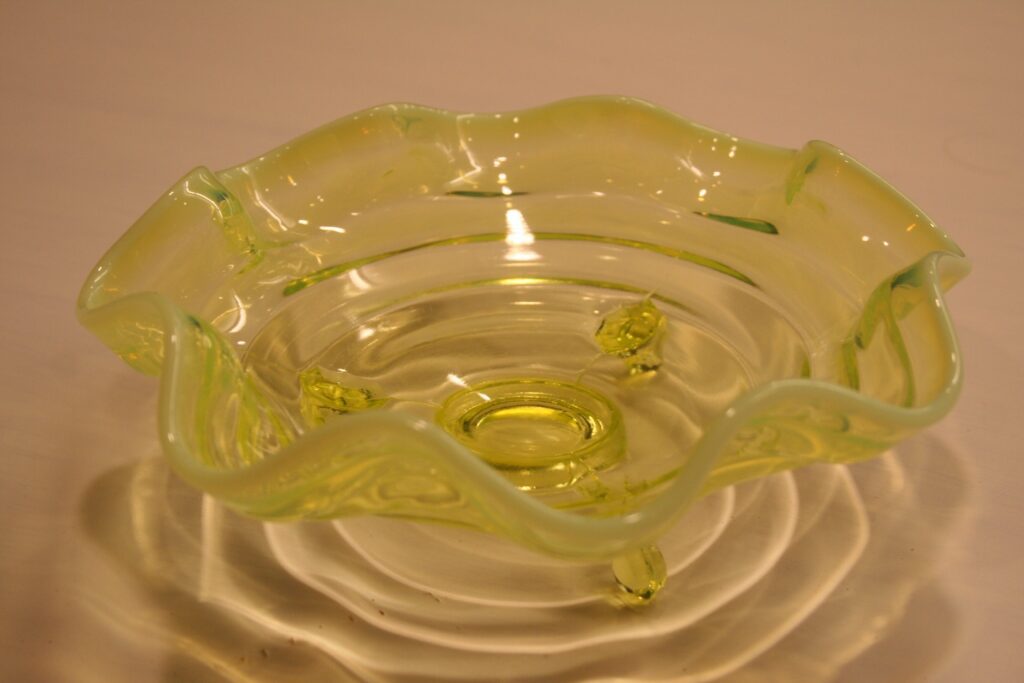
Uranium glass fluoresces or glows in the dark because of the presence of uranium in the glass mixture. Collectors collect uranium glass actively from some of the best-known manufacturers such as: L. G. Wright, Buckeye Glass Company of Martin’s Ferry, OH, Mosser Glass of Cambridge, OH, Gibson of Milton, WV, Adams & Company, Boston & Sandwich Glass of Sandwich, Cape Cod, MA, Northwood & Co. in Wheeling, VA, Fenton, Steuben Glass, Degenhart Glass Co., Viking, Heisey, Fostoria of Fostoria, OH, McKee & Bros. of Pittsburgh, PA, Imperial, Westmoreland Glass Co., Summit of Akron, OH, West Virginia Glass & Mfg. Co., O’Hara Glass Company of Pittsburgh, PA, Thomas Webb & Sons, the Pairpoint Mfg. Co. of New Bedford, MA, a firm that made Canaria vaseline glass for a few years only in the 1920s and Baccarat, known for making crystal and the firm made cristal dichroide in the 1840s.
Safety questions arise when it comes to understanding uranium glass and collecting it. Uranium glass has a small number of radioactive elements. In a 2001 report, uranium glass was deemed safe by the U.S. Nuclear Regulation Commission. These pieces of glassware have a very small amount of radioactivity, but the glowing color of uranium glass is not caused by radiation. Uranium glass is safe to store, display, and collect.
Ph.D. antiques appraiser, author, and award-winning media personality, Dr. Lori presents antique appraisal events nationwide, appears on Netflix’s King of Collectibles, History channel’s The Curse of Oak Island and Pawn Stars do America. Visit www.DrLoriV.com, watch videos on www.YouTube.com/DrLoriV or call (888) 431-1010.