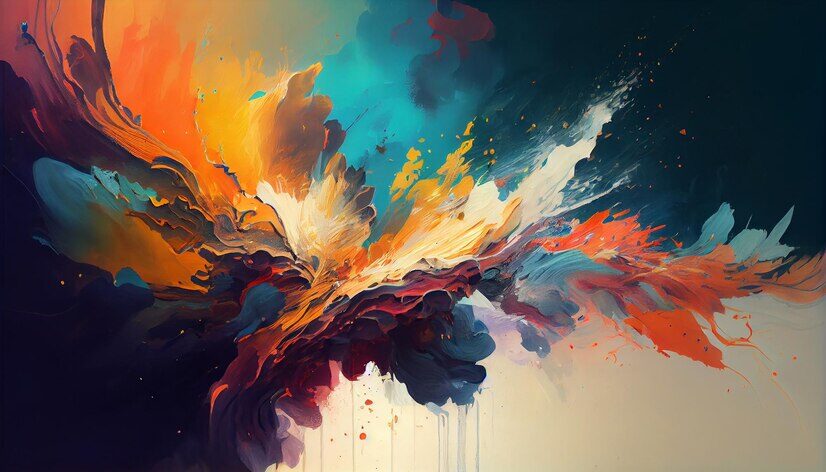
Imagine a canvas not as a window to a scene but as a portal to raw emotion. Colors explode across the surface, swirling, dripping, and pulsating with life. This is the world of colorful abstract paintings. Here, color reigns supreme—a vibrant dance on the cusp of chaos and creation.
This guide is your invitation to step into an exhilarating realm. Here, we’ll explore how today’s artists are pushing the boundaries of color as they aim to create visually stunning and profoundly moving artworks.
Historical Perspective
Abstract art’s vibrant tapestry is woven from the threads of past movements. We trace our journey back to the early 20th century. Pioneers like Kandinsky and Mondrian challenged the dominance of figurative art. They saw color not as a mere descriptor but as a force capable of evoking emotions and sparking introspection.
Abstract Expressionism, spearheaded by Pollock and Rothko, unleashed color’s full potential. It transformed canvases into arenas of gestural energy and emotional depth. These movements laid the groundwork for the contemporary celebration of color. And it paved the way for even bolder experimentation.
The Pop Art Influence
Mid-century Pop Art injected a dose of audacious vibrancy into the abstract scene. Warhol’s Day-Glo soup cans and Lichtenstein’s Ben-Day dots redefined how color could be used to comment on mass culture and consumerism.
Pop Art continues to have a strong impact today. Artists like Takashi Murakami and Jeff Koons use vibrant colors and bold designs. They create powerful and thought-provoking artworks.
The Drip Technique
Jackson Pollock’s iconic drip paintings redefined the very act of painting. He suspended canvas from the ceiling and dripped paint directly onto it. He created a new relationship between artist and canvas, where chance and spontaneity took center stage. The resulting works are explosions of color, gestural lines weaving a mesmerizing dance across the surface.
Contemporary artists like Helen Frankenthaler and Sean Scully have built upon Pollock’s legacy. They reinterpreted the drip technique to create works ranging from ethereal washes to dynamic geometric compositions.
Bursting with Creativity
Today’s abstract artists are pushing the boundaries of color beyond the confines of traditional paint.
You can see resin sculptures shimmering with iridescent hues. The neon installations pulsing with electric energy. And the fire performances where color dances in flames.
Artists like Anish Kapoor and Yayoi Kusama use unconventional materials and techniques. They create immersive experiences that engulf the viewer at online art exhibitions in a kaleidoscope of color.
Technological Advancements
The digital age has opened new doors for color exploration in abstract art. Artists like James Turrell and Rafael Lozano-Hemmer use digital tools for online art exhibitions. They also use interactive installations. This creates an environment where color becomes an immersive experience. It shifts and responds to the viewer’s movements.
These works challenge the traditional definition of a “painting” and showcase the endless possibilities of color in the digital realm.
Case Studies
Let’s look at specific works that exemplify the celebration of color in cutting-edge abstract art.
- Consider Julie Mehretu’s dynamic compositions. She has featured layers of vibrant acrylics and ink, building into intricate narratives of urban landscapes.
- When you will delve into the immersive world of Anish Kapoor’s “Descent into Limbo.” He created a swirling vortex of black paint that consumes the viewer in a profound meditation on darkness and light.
Each of these artworks showcases a unique approach to color, demonstrating its power to evoke emotion, create space, and tell stories.
Emerging Trends
The abstract color revolution is far from over. Nowadays, artists are exploring bioluminescent pigments that glow in the dark. They experiment with augmented reality experiences that blend the physical and digital realms.
Moreover, they are also using artificial intelligence tools to create algorithms that generate ever-evolving color patterns. These trends point towards a future where the boundaries of color are constantly being redefined. Thus pushing the limits of their imagination and perception.
The Impact of Color Psychology
Color is not just a visual phenomenon; it’s a powerful psychological tool. As an artist, you might be aware of how different colors evoke specific emotions and reactions in the viewer.
For example, A fiery red might pulse with anger, while a serene blue might induce a sense of calmness.
Therefore, understanding color psychology allows artists to create works that dazzle the eye and resonate deeply emotionally.
Conclusion
The celebration of colorful abstract paintings is a testament to the boundless creativity of the human spirit.
From the bold explosions of Pop Art to the ethereal washes of digital projections, artists use color to push boundaries, challenge perceptions, and create inspiring artworks.
So, step into this vibrant world, open your eyes to the possibilities, and let the colors wash over you.