


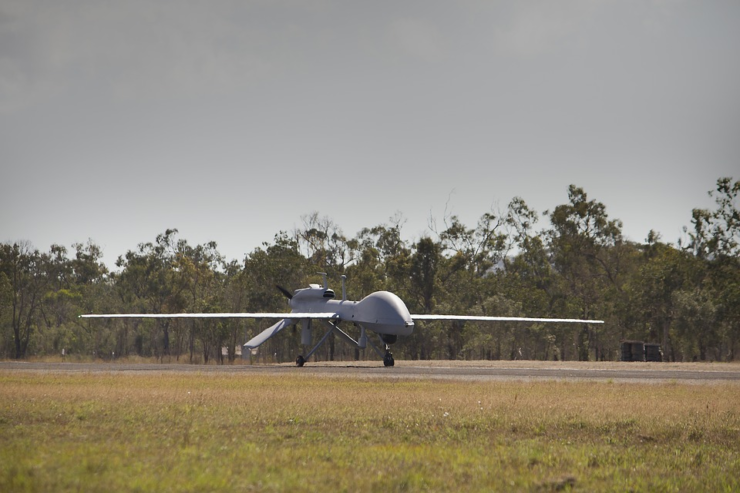
Drones are becoming an integral part of modern warfare. Recent conflicts have shown just how valuable drones are as an asset, and how they can completely change the course of a conflict.
Armed drones are slowly becoming an integral part of close air support, working in combination with CAS aircraft to provide precision fire support to troops in contact. However, current UAV developments are promising to expand the use of drones on modern battlefields.

Modern UCAVs
Not so long ago, UAVs and UCAVs used to be niche technologies used by the most technologically advanced militaries of the world. That time is long gone. UCAVs have evolved to a point where they are affordable (relative to alternative solutions), reliable, and capable of carrying a wide range of payloads.
Most world militaries are operating some type of drone program. Some have concluded that drones are a cost-effective solution to battlefields heavily saturated with long-range and short-range air defense systems (SHORAD).
Case in point, the Nagorno-Karabakh conflict. The Azerbaijan military has found that their UAVs and UCAVs were capable of penetrating Armenian air defenses with minimal losses. The small radar footprint of Azeri UCAVs and loitering munitions has allowed them to engage targets all along the front lines as well as deep behind enemy lines, with almost complete impunity.
Loitering Munitions – The Not So Silent Killer
One of the more interesting developments in the UCAV world was the proliferation of loitering munitions or suicide drones. Israeli IAI Harop is currently being used in Syria where it is neutralizing critical infrastructure and military equipment deemed a threat by the IDF. The effectiveness of this platform is borderline scary.
However, Harop was also used in Nagorno-Karabakh, where those on the receiving end noticed a Stuka-like whine coming from the drone as it engaged targets with impunity. Loitering munitions such as Harop are SEAD optimized and capable of engaging sources of radar radiation completely autonomously.
Drones In Logistics Role
The ISR (Intelligence, Surveillance, Reconnaissance) and ground support roles are no longer the only missions drones can be tasked with. Modern multi-mission multi-payload drone designs allow drones to deliver critical supplies to troops on the battlefield. The use of drones in logistical roles means that supplies can reach those who need them the most in record time.
Furthermore, flying supplies over to the front lines reduces the risk of ambushes and loss of life. Modern drones of this type can carry 45 kg of supplies and reach destinations within a 10 km radius.
The multi-role nature of such drones allows them to be used for both ISR and more, depending on the nature of the mission.
Offensive Drones In Asymmetrical Warfare
State actor militaries aren’t the only ones using drones. Many insurgent organizations in Syria, Iraq, and elsewhere have developed their own offensive drones. Despite being based on civilian models, such drones have been proven to be extremely effective in gathering intelligence and even delivering a rudimentary payload to targets.
As an ISR platform, commercial drones were, and still are being used in the Middle East as well as Eastern Ukraine. There, different factions are relying on drone feeds to correct fire solutions for entire artillery and rocket artillery batteries.
Field commanders and skillful mortar teams use this data to make quick corrections to their fire solutions, thus increasing their effectiveness against the enemy. Both the Ukrainian military and separatist forces in the east have had plenty of success in inflicting serious losses to well-dug in positions and bunker networks.

Over in Yemen, Houthi forces have built their own drones by copying the Iranian Abadil UAVs, proving once and for all that non-state actors are perfectly capable of executing drone operations against a conventional military — in this case, the Saudi alliance.
Houthis have been surgical with their homemade loitering munitions, hitting targets deep inside Saudi Arabia. Saudi oil refineries and even airports have been struck with such munitions. The fact that Houthis, an irregular insurgent force, is capable of manufacturing their own loitering munitions goes to show just how far drones have penetrated the asymmetrical side of warfare.
The Future Is Autonomous
Once fully autonomous UCAVs and loitering munitions become a thing, we will see a massive shift in anti-air doctrines as well as anti-air technology as a whole. Modern SHORAD systems aren’t capable of effectively eliminating the threat imposed by drones.
Once UAVs, UCAVs, and loitering munitions become even smaller, current SHORAD systems will most likely become completely obsolete. The way things are going now, most major players are heavily involved in the research and development of new drone technologies. The very next conflict could be the testing ground for fully autonomous drones.






