With the busy and hectic schedule that modern-day people have today, health is easily overlooked. That’s why it’s important to always be reminded to exercise, eat right, and eat healthily. It’s also crucial to keep track of everything to avoid regretting at the end for not taking care of your health.
One way to ensure long-term health is tracking. People nowadays use digital technology to track health using wearable devices, such as smartwatches or fitness trackers. But, why is tracking your health highly beneficial in the long term?
In this post, you’ll learn the reasons why tracking your health is beneficial in the long run and ways to attain your health and fitness goals.

sport, technology and lifestyle concept – happy couple with fitness trackers running along bridge in summer
Increase of Health Status Awareness
By tracking your health using wearable technology, you’ll increase your awareness about your current health status. Smartwatches and fitness trackers have sophisticated sensors and apps that send a notification to your phone or smart speaker if there’s something wrong with your heart rate or other vital signs.
You can always find the best wearable devices online at Biostrap.com.
Here are the best features and benefits of smartwatches or fitness trackers:
- Touchscreen and High Visibility Display: An important aspect of a fitness tracker is the display in which checking the style and functionality is important. Consider checking the visibility of the display in different light conditions, its ease of use, and how intuitive its user interface is.
- Fitness App: A fitness tracker interacts with an app, and you should know what the fitness app is like before buying a tracker. Choose one that consistently offers regular updates and gets good reviews. Always check for compatibility and some specific features, such as the option of tracking food.
Track Water Activity Performance for Long-term Health
Swimming is a fun and exciting physical activity that is quite difficult to track if you’re doing it solo. Choosing a fitness tracker that is waterproof or water-resistant is a good way to track your health when doing water activities. But what’s the difference between a waterproof and a water-resistant fitness tracker?
Here are the good-to-know facts about water-resistant fitness trackers and water ratings:
- If you’re planning to run in the rain, swim, or shower with your fitness tracker, this designation is important.
- Remember that no device is totally waterproof. Different devices have some water resistance levels, and the specs tell exactly how resistant the device is, which is called the ATM rating. For example, 5 ATM would mean that the device is water-resistant up to 50 meters below the surface.
- The higher the number, the better. If you prefer a fitness tracker you can fully submerge and swim laps with, find one with at least 10ATM/100 Meters.
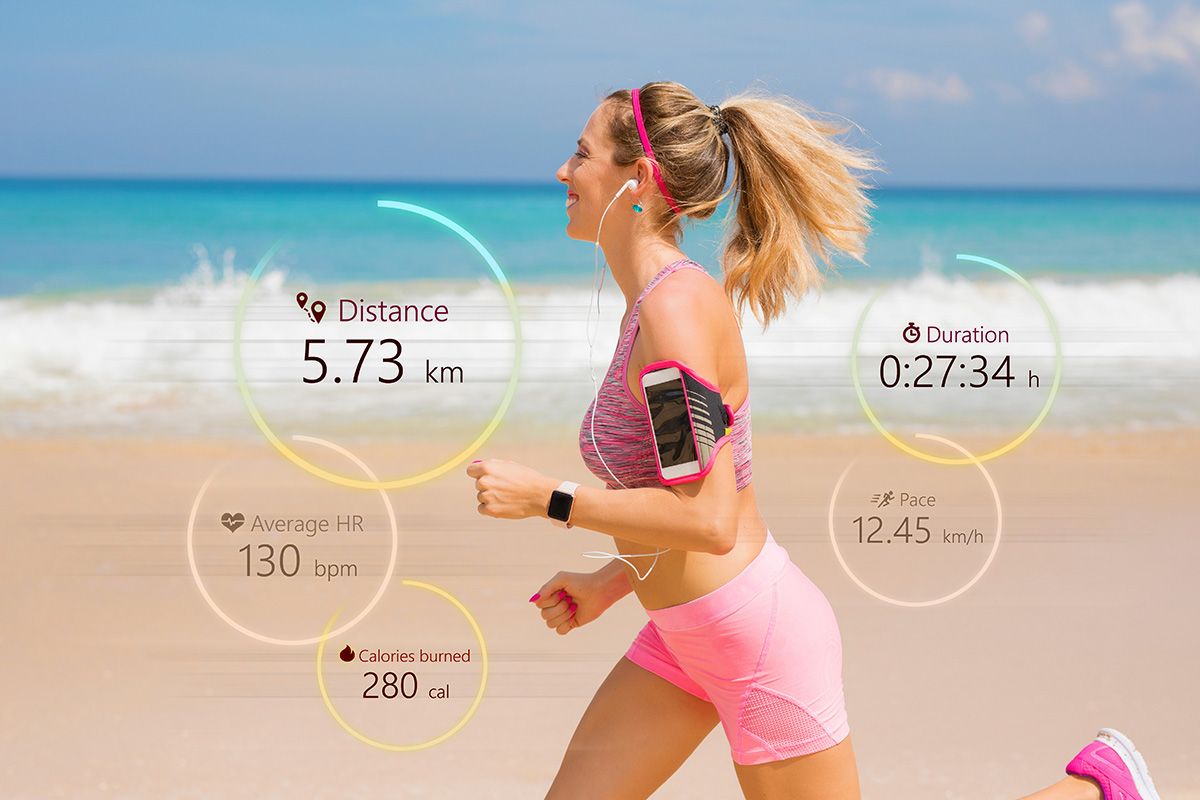
Woman running, wearable tech concept
Ensure That You Get Enough Sleep for Physical and Mental Health
Are you suffering from insomnia or just couldn’t sleep restful enough for the past days or weeks? With sleep tracking, you’ll be aware of your sleep behavior and sleep cycle, and get appropriate medical intervention if needed. Most wearable fitness trackers can track sleep, and they usually differ in accuracy and quality.
If sleep tracking is very important to you, choose a fitness tracker with a sleep tracking feature. There are fitness trackers that you can just press a button whenever you go to bed to record sleep data, and there are those with sensors and can determine sleep stages based on your movements and heart rate during hours of sleep.
A fitness tracker with a sleep tracking feature is very useful so that you’ll have an idea of your sleep patterns, focusing on your overall health. For those who suspect sleep disorders, talk to your doctor immediately for prompt intervention.
Track Athletic Performance and Overall Health
Tracking health for athletes is also important. Aside from this, there are also fitness trackers that have a Global Positioning System or GPS feature, which is very handy for runners and cyclists. If you love jogging, running, or biking, choosing a fitness tracker with a GPS feature is highly recommended. With this feature, you can also gauge your athletic performance based on your route, distance, and time allotted to reach your destination.
Here are different types of GPS options in wearable fitness trackers today:
- Built-in GPS: The fitness tracking device is equipped with GPS (built-in). With built-in GPS, you don’t have to carry your smartphone with you to collect data. Usually, fitness trackers with GPS features have a shorter battery life and are more expensive than those without this feature.
- Linked GPS: The fitness tracker can be paired with a smartphone to obtain GPS data. If you’re shopping for a fitness device that is GPS-equipped, consider the battery life to ensure that the device will last during your entire run.
Promote Cardiovascular Health
Counting steps reigned as the go-to metric for fitness trackers in the past. However, heart rate monitoring nowadays has also become an essential feature because tracking your heart rate reflects cardiovascular endurance. It allows you to determine how hard you can push yourself doing a specific workout, most especially if your fitness tracker provides data of the time you spent in different heart rate zones. Also, this feature measures your overall health and fitness over time, based on your resting heart rate.
More trackers are equipped now with heart rate monitors. You’ll find dedicated heart rate trackers worn around the chest, wrist, or arm.
Here are the three places you can wear a heart rate monitor tracker:
- Chest Heart Rate Monitor: Of all the places you can wear a heart rate monitor, the chest is the best area if you aim accuracy during a workout, most especially if your training is based on your heart rate or you’re doing a high-intensity training session. Chest strap heart rate monitors provide more accurate and faster readings than armband or wrist trackers.
- Wrist Trackers: If you want a more convenient and comfortable tracker to wear, a wrist tracker is highly recommended. It’s a helpful tool to measure general cardiovascular health because you can wear it anytime and anywhere to measure your resting heart rate. Newer fitness trackers also come in light and small devices that sit snugly against the wrist with a screen, displaying how hard the heart is working.
- Armband Trackers: They’re optical heart rate monitors like fitness trackers which are positioned in the forearm, around the thigh or upper arm. You’ll get a more reliable reading with this device as compared to the wrist tracker. As compared to chest trackers, armband trackers are easier to slip on. You don’t need to wear an armband tracker outside workouts, measuring resting heart rate, and also attain improved sleep tracking.
Reduce the Risks of Developing Chronic Diseases
Tracking your health also involves undergoing general checkups every year. By undergoing regular annual checkups, you’ll reduce your risks of developing chronic diseases in the long-term, such as arthritis, heart disease, and degenerative diseases, such as Alzheimer’s and Parkinson’s Disease.
In an annual checkup, different laboratory and scan studies will be carried out to assess your overall health, including the following:
Complete Blood Count and Platelet Count: These tests evaluate the presence of blood disorders.
- Blood Chemistry: This laboratory exam tests kidney and liver function.
- Blood Glucose Levels: Testing blood sugar levels to diagnose diabetes.
- Cholesterol and Triglyceride Levels: It’s a test to help rule out heart disease and atherosclerosis.
- Chest X-ray: It is used to diagnose lung abnormalities and diseases.
- Urinalysis: This test evaluates urinary tract infection.
- Pap Smear: It tests the presence of abnormal cells in the cervix that may cause cervical cancer.
- Dental Checkup: It’s part of the annual checkup to ensure optimum dental health.
These tests reflect baseline data to help the doctor diagnose any current or potential diseases.
Strengthen Your Immunity
Tracking your health is highly beneficial in strengthening your immunity. One aspect is ensuring that you eat the right food at the right time and with the right amount of nutrients. Of course, a vital aspect of strengthening your immunity is ensuring that you get the right amount of sleep to help your cells and tissues recover.
Here are the important health aspects that you need to track to strengthen your immunity:
- Weight: By tracking your health, you avoid overeating that may lead to obesity and attracting infection that is caused by increased byproducts, toxins, and microorganisms that are introduced by different high-sugar and carb food sources.
- Food Intake: Choose foods and drinks that are healthy and avoid processed foods and high-sugary or high carb foods. Eating a balanced diet can be achieved by recording your food intake using a daily journal or food app tracker.
- Dietary Supplements: Also, taking multivitamins and other dietary supplements can also help strengthen your immune system so your body can fight bacteria, viruses, and other microorganisms.
- Exercise: Tracking your physical activities and workout is important to strengthen your immunity, endurance, and stamina. If you’re not a gym fanatic, doing different physical activities, like yoga or Pilates, can help your body move, test reflexes, improve coordination, and balance, along with improving your overall health and fitness.
Other Ways to Track Your Health
- Track Your Health Using Your Phone
Tracking your health is also possible using just your phone. It can track your health and fitness, like tallying your calories, monitor your sleeping patterns, and more.
Here are some helpful mobile apps to help you track your health and get the most from your smartphone:
- Food Tracking Apps: You’ll find helpful food tracking apps to track your hunger, mood, and sleep levels, providing feedback to help you attain your health and fitness goals. Choose an app that can scan barcodes to let you know how healthy or unhealthy a food product is.
- Fitness Tracking Apps: Get to track your exercise, sleep, and diet using a fitness tracking app downloaded on your smartphone. It will be easier for you to set goals, losing or maintaining weight by calculating how many calories your body needs each day.
- Fitness Challenges Apps: These apps are great for cyclists, runners, and bikers. It can track speed, distance, elevation, heart rate, and calories burned. You can join challenges with other app users and track mileage.
- Sleep Cycle Apps: It measures sleep cycles, waking you up within 30 minutes when the alarm is set to go off. Place your smartphone to monitor movement. The sleep cycle app can tell your sleep phase so you can adjust your wake-up time and align it with your lightest sleep phase.
- Health Journal
By keeping a health journal, you can easily track your health without needing any digital device. You can use a notebook or any customized notepad to write your health goals, actionable steps, and other data that is relevant in attaining your health goals.
- Oversized Calendar
Physical oversized calendars can be installed in any wall area at home so you can easily see it when you get up. It keeps you reminded of your daily workout regimen and other tasks for time management and balanced work and life.
- Healthcare Professional Assessment
Healthcare professionals are the best people to help you track your health. By having a baseline medical record, you can track your health every year. Aside from annual physical checkup, it’s important to undergo specific healthcare assessments including the following:
- Eye or Vision Test: An optometrist or ophthalmologist can be sought to check your vision or eye health. It should be done on a yearly basis to avoid eye problems, such as astigmatism, nearsightedness, farsightedness, glaucoma, and cataract.
- Psychiatric Evaluation: Mental health assessment is important for both people with mental disorders and psychologically healthy individuals. Annual psychiatric assessment and counseling are important to address anxiety and other mental health disorders.
Conclusion
Tracking your health is important for long-term health and wellness by using fitness trackers, smartphone apps, and other digital and traditional means of health monitoring to meet your health and fitness goals. By tracking your health, you’ll improve your cardiovascular health, immunity, and maintain your ideal body weight. Also, it will help you avoid medical ailments, such as degenerative disorders and other chronic diseases.
Other than long-term physical benefits, monitoring your health also gives you self-fulfillment and improved psychological health brought about by looking better and healthier. Indeed, monitoring your health regularly will give you a better quality of life in the long run. With the help of fitness trackers, healthcare professionals, and medical devices, you can monitor your health and gain long-term health benefits.