Katy and surrounding communities could enjoy one of the best nights of stargazing this year as the 2026 Perseid meteor shower reaches its peak Wednesday night, August 12, into early Thursday morning, August 13.
The Perseids are known for producing bright, fast-moving meteors and occasional fireballs that leave colorful trails across the sky. This year’s display could be especially impressive because the shower coincides with a new moon, meaning moonlight should not interfere with visibility. Under ideal dark-sky conditions, observers could see as many as 50 to 100 meteors per hour during the most active periods, although residents watching from lighted neighborhoods will likely see fewer. NASA describes the Perseids as one of the brightest and most popular meteor showers of the year.
What Time Should Katy Residents Watch?
The meteor shower can be watched throughout the night, but Katy-area residents should use the following schedule:
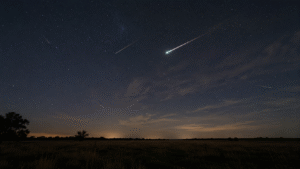
Katy-area residents can watch the Perseid meteor shower peak overnight August 12–13, weather permitting.
- Viewing begins: Around 10 p.m. Wednesday, August 12
- Better viewing: After midnight
- Best Katy-area viewing window: Approximately 1 a.m. to 5 a.m. Thursday, August 13
- Morning twilight begins: Around 5:23 a.m.
- Sunrise: Approximately 6:49 a.m.
The number of visible meteors should generally increase as the night continues and the constellation Perseus rises higher in the northeastern sky. NASA says the Perseids are best observed during the predawn hours, although some meteors may become visible as early as 10 p.m. NASA Science
Where Should You Look?
Begin by facing the northeastern sky, where the meteors appear to originate near the constellation Perseus. However, do not stare at only one location. Perseid meteors can streak across almost any part of the sky, so an open area with a wide view will provide the best experience.
No telescope or binoculars are needed. In fact, viewing with the naked eye is better because it allows you to see more of the sky at once.
Where Can Katy-Area Residents Watch?
Residents may be able to see the brightest meteors from their yards, neighborhood green spaces or other open areas where nighttime access is permitted. Turn off nearby outdoor lights when possible and position yourself away from streetlights, parking lots and illuminated buildings.
For darker skies, consider traveling west or northwest of Katy toward less-developed areas near Brookshire, Pattison, Waller or surrounding rural communities. Always use a location that is legally open, obtain permission before entering private property and never stop along a highway or dark roadway to watch.
Katy-Area Weather Outlook
The current forecast calls for partly cloudy, warm and humid conditions Wednesday night, with temperatures near 80 degrees. Passing clouds could temporarily block the view, but breaks in the cloud cover may still give residents opportunities to see meteors. Check the latest National Weather Service Houston–Galveston forecast before leaving home because cloud conditions can change.
Tips for Seeing More Meteors
- Find the darkest safe location available.
- Allow your eyes about 30 minutes to adjust to the darkness.
- Avoid looking at phones, headlights and bright flashlights.
- Place your phone on its lowest brightness setting.
- Bring a reclining chair or blanket so you can comfortably watch a large section of the sky.
- Pack water and insect repellent for the warm, humid evening.
- Watch patiently for at least 30 to 60 minutes because meteors often appear in bursts.
- Skywatching Tips From NASA
The Perseids occur when Earth passes through a trail of dust and debris left behind by Comet 109P/Swift-Tuttle. When those particles enter Earth’s atmosphere at high speed, they burn up and create the streaks commonly called “shooting stars.”
For Katy, Fulshear, Brookshire, Cinco Ranch and surrounding residents, the simplest advice is: go outside after midnight, find the darkest safe location possible, face generally northeast and keep watching until about 5 a.m.