By: Staff Editor
The centennial World Cup will cross three continents, with Morocco, Portugal and Spain serving as the main hosts and historic opening matches played in South America.
By: Staff Editor
KATY, Texas — One day after Spain lifted the 2026 FIFA World Cup trophy, attention is already turning toward an unprecedented centennial tournament in 2030.
The 2030 FIFA World Cup will be staged across six countries on three continents. Morocco, Portugal and Spain will serve as the tournament’s principal hosts, while Argentina, Paraguay and Uruguay will each hold one special opening match celebrating 100 years of World Cup history.
Spain will enter the next tournament as defending champion after defeating Argentina 1-0 in extra time Sunday. The victory gave Spain its second men’s World Cup championship and created an immediate connection between the tournament that just ended and the one arriving four years from now.
But the 2030 World Cup will be unlike anything soccer has previously attempted.
Where Will the 2030 FIFA World Cup Be Played?
The primary 2030 FIFA World Cup host countries are:
- Morocco
- Portugal
- Spain
Three centenary celebration matches will also be played in:
- Argentina
- Paraguay
- Uruguay
FIFA formally approved the hosting arrangement during an Extraordinary FIFA Congress involving all 211 member associations. Under the plan, Morocco, Portugal and Spain will host most of the tournament, while the three South American countries will each stage one official World Cup match.
The arrangement makes the 2030 World Cup the first edition played across three continents: Africa, Europe and South America.
According to FIFA’s official 2030 World Cup information, all six host countries will qualify automatically for the tournament.
Why Will the World Cup Begin in South America?
The special format recognizes the 100th anniversary of the first FIFA World Cup, which was held in Uruguay in 1930.
Uruguay won that inaugural tournament after defeating Argentina 4-2 in the championship match at Estadio Centenario in Montevideo.
A century later, the World Cup will return to the historic stadium for the first of the three centenary matches. Argentina and Paraguay will then stage one match each before the tournament’s focus shifts to Morocco, Portugal and Spain.
FIFA described the South American matches as an opportunity to honor the origins of the competition while connecting its history to a new generation of players and supporters.
The tournament will therefore begin where the World Cup’s story started before moving across the Atlantic for the remaining competition.
How Will the South American Opening Matches Work?
The three matches in Argentina, Paraguay and Uruguay will be official tournament games—not exhibitions or ceremonial friendlies.
Each South American host will participate in a match on its home continent. Their opponents will also begin the World Cup in South America before traveling to the main host region.
FIFA has said the intended schedule will give the six teams involved approximately 11 or 12 days for travel and rest before playing their second tournament matches.
That extended break will be important because the teams must travel thousands of miles, cross several time zones and adjust from South American conditions to locations in Africa or Europe.
The remaining matches will then be held primarily in the much more compact region encompassing Morocco, Portugal and Spain.
Spain Returns as Champion and Host
Spain’s place at the center of the 2030 tournament became even more significant following its 2026 championship victory.
Ferran Torres scored in the 106th minute to defeat Argentina 1-0 in the 2026 final at New York New Jersey Stadium. The victory gave Spain its first men’s World Cup championship since 2010.
Read The Katy News’ complete report: Spain Wins 2026 FIFA World Cup, Defeats Argentina 1-0.
Spain will now spend the next four years preparing to defend its championship while helping organize the world’s largest soccer tournament.
The country previously hosted the World Cup in 1982. Its proposed 2030 venues have included internationally recognized stadiums in Madrid, Barcelona, Bilbao, Seville and other Spanish cities.
However, the Spanish Football Federation said in March 2026 that the host-city selection process remained open and that FIFA technical visits to candidate venues were continuing. Fans should therefore treat current stadium lists as proposed locations until FIFA publishes the final match schedule.
Portugal Prepares for Its First Men’s World Cup
Portugal has hosted major international soccer competitions, including the 2004 UEFA European Championship, but it has never hosted the men’s FIFA World Cup.
Lisbon and Porto are expected to play central roles in Portugal’s participation. The country’s bid included Estádio da Luz, Estádio José Alvalade and Estádio do Dragão among its proposed venues.
Portugal’s location beside Spain should make travel between most European host cities relatively manageable. Rail lines, highways and short flights already connect the two countries.
The 2030 tournament could also carry special emotional significance for Portuguese supporters as the country celebrates its soccer history and the international influence of stars such as Cristiano Ronaldo.
Morocco Makes African World Cup History
Morocco will become only the second African country to host men’s World Cup matches, following South Africa in 2010.
The country’s involvement also marks the first time World Cup matches will be played on both sides of the Mediterranean during the same tournament.
Morocco has invested heavily in stadiums, transportation and other infrastructure as it prepares for 2030. Candidate host cities have included Casablanca, Rabat, Tangier, Marrakesh, Fez and Agadir.
The joint hosting arrangement gives FIFA a relatively concentrated main tournament footprint. Southern Spain and northern Morocco are separated by the Strait of Gibraltar, while Portugal borders Spain.
Even so, supporters planning to attend matches in multiple countries will need to consider passport requirements, border procedures, transportation and lodging.
Which Countries Have Already Qualified for 2030?
Six countries have secured automatic qualification because of their hosting roles:
- Argentina
- Morocco
- Paraguay
- Portugal
- Spain
- Uruguay
Every other national team—including the United States—will need to qualify through its regional competition unless FIFA changes the qualification rules.
That means the United States will not receive the automatic host position it received for the 2026 tournament in North America. The U.S. men’s national team is expected to compete through the Concacaf qualification process for an opportunity to reach 2030.
The complete qualification schedule and regional allocation of tournament positions will be announced later.
Will the 2030 World Cup Have 48 or 64 Teams?
The 2026 FIFA World Cup was the first edition expanded from 32 to 48 teams.
On July 20, 2026, CONMEBOL President Alejandro Domínguez publicly called for the 2030 centennial tournament to expand temporarily to 64 teams. The proposal would allow more countries to participate in the 100th-anniversary celebration.
However, FIFA has not approved a 64-team format.
For now, the proposal should be treated as an idea under discussion—not a finalized change. Expanding to 64 teams would require FIFA to reconsider qualification allocations, the number of matches, the length of the tournament, stadium use and player workload.
A larger field would also create more travel and logistical demands for a competition already spread across six countries and three continents.
Until FIFA issues an official decision, supporters should be cautious about reports describing the 2030 format as finalized.
Have the 2030 Schedule and Stadiums Been Announced?
FIFA has confirmed the host countries and the general structure of the centenary celebration, but several important details remain undecided or unpublished.
As of July 20, 2026, FIFA had not released the complete:
- Match schedule
- Final list of host cities
- Final stadium assignments
- Group-stage draw
- Qualification schedule
- Opening-match opponents
- World Cup final location
- Public ticket-sales calendar
Multiple stadiums have been included in host-country planning documents, but candidate venues should not be confused with a finalized FIFA schedule.
The Katy News will update this coverage as official announcements are made.
Are 2030 World Cup Tickets Available?
Official public ticket sales have not started.
Fans should avoid websites claiming to offer guaranteed 2030 match tickets before FIFA announces its authorized sales process. During major sporting events, unofficial sellers frequently advertise speculative tickets or packages before seats are available.
Supporters interested in attending should monitor FIFA’s official website and the national soccer federations of the six host countries.
Travelers should also wait for the match schedule before making nonrefundable hotel or transportation reservations. A ticket to a South American centenary match would involve an entirely different travel plan from a match in Spain, Portugal or Morocco.
What Does the 2030 World Cup Mean for Katy and Houston Fans?
Houston will not serve as a host city in 2030, but the enthusiasm created by the 2026 tournament is likely to continue throughout Greater Houston.
Houston hosted seven matches during the 2026 World Cup, bringing national teams and supporters from around the world to Southeast Texas. Katy-area restaurants held watch parties, families attended fan events and young soccer players had an opportunity to see the world’s largest tournament arrive in their region.
The four-year period leading into 2030 presents an opportunity for local youth leagues, schools, clubs and businesses to continue building on that momentum.
Local restaurants and event organizers can also prepare for future international watch parties by listing their businesses and events with the Katy News Business Directory.
Readers can follow future tournament announcements, local watch parties and soccer coverage through The Katy News App.
What Makes the 2030 World Cup Historic?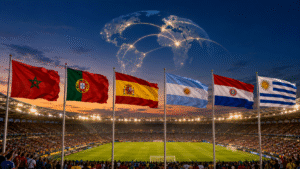
Every World Cup creates memorable goals, players and celebrations. The 2030 edition will also represent a direct connection between the tournament’s beginning and its future.
It will:
- Celebrate the World Cup’s 100th anniversary
- Begin where the first tournament was held
- Include six automatically qualified host countries
- Span Africa, Europe and South America
- Bring men’s World Cup matches to Morocco for the first time
- Bring the tournament to Portugal for the first time
- Return the competition to Spain after 48 years
- Potentially introduce additional changes to the expanded format
The 2026 tournament demonstrated the enormous reach of a 48-team World Cup across Canada, Mexico and the United States. The 2030 edition will attempt something even more geographically ambitious.
From Spain’s Victory to the World Cup’s Next Chapter
Spain’s celebration is only beginning after its dramatic victory over Argentina.
But the countdown to 2030 has already started.
Four years from now, the defending champions will welcome the soccer world to Spain while sharing hosting responsibilities with Portugal and Morocco. Before that main portion begins, the tournament will return to Argentina, Paraguay and Uruguay to honor the South American roots of the competition.
The final stadiums, match schedule, ticket process and tournament format are still developing. The most important fact, however, is already confirmed: the 2030 FIFA World Cup will be a global centennial celebration unlike any previous edition.
Frequently Asked Questions
Where will the 2030 FIFA World Cup be held?
Morocco, Portugal and Spain will serve as the principal hosts. Argentina, Paraguay and Uruguay will each stage one centenary celebration match.
Which country will host the first match?
FIFA has said the first centenary match will be played at Estadio Centenario in Montevideo, Uruguay, where the 1930 World Cup final was held.
Will Spain automatically qualify?
Yes. Spain, Morocco, Portugal, Argentina, Paraguay and Uruguay will all qualify automatically because of their hosting roles.
Will the United States automatically qualify?
No. The United States is not a 2030 host and is expected to qualify through Concacaf unless FIFA changes the qualification process.
Will the 2030 World Cup have 64 teams?
A 64-team tournament has been proposed by CONMEBOL’s president, but FIFA has not approved the expansion. It remains a proposal.
Are tickets available now?
No official public ticket-sales calendar has been announced. Fans should only purchase tickets through FIFA or an officially authorized provider once sales begin.
Has the 2030 World Cup final location been selected?
FIFA has not publicly announced the final stadium. Locations in Spain and Morocco have been discussed, but supporters should wait for an official decision.