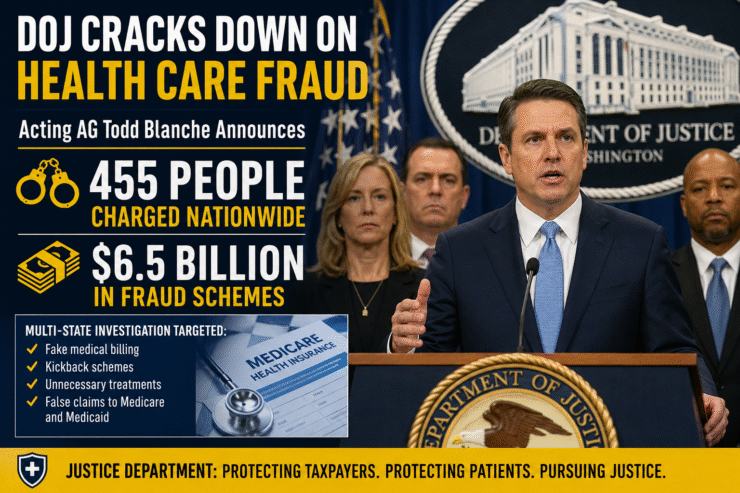
WASHINGTON — The U.S. Department of Justice has announced what officials describe as the largest coordinated health care fraud enforcement action in American history, charging 455 individuals in schemes involving more than $6.5 billion in false claims submitted to government health care programs.
Acting Attorney General Todd Blanche announced the nationwide operation on June 23, stating that federal and state investigators targeted fraud schemes involving Medicare, Medicaid, and other taxpayer-funded health care programs. The enforcement action spans 45 states and includes physicians, nurse practitioners, business executives, marketers, and other individuals accused of exploiting the health care system for financial gain.
“This announcement marks the greatest combined federal and state effort in combating health care fraud in history,” Blanche said during a Department of Justice press conference.
Billions in False Claims
According to federal officials, the defendants allegedly participated in a wide range of fraudulent activities, including billing for services that were never provided, paying illegal kickbacks, submitting false diagnoses, and exploiting vulnerable patients to generate Medicare and Medicaid reimbursements. The schemes involved more than $6.5 billion in fraudulent claims.
Among the cases highlighted by prosecutors was an Arizona-based wound care scheme in which an executive and 10 other defendants allegedly billed Medicare more than $4 billion for amniotic wound allografts. Investigators claim the products were purchased from tissue banks, relabeled, and sold at markups exceeding 2,000 percent. The operation allegedly received approximately $2 billion in taxpayer-funded reimbursements.
Federal authorities allege proceeds from the scheme were used to purchase luxury homes, high-end vehicles, expensive jewelry, and even a multimillion-dollar resort in the Philippines.
Medical Professionals Among Those Charged
The Justice Department said the defendants include approximately 90 physicians and other licensed medical professionals. Investigators also announced charges involving hospice care fraud, unnecessary medical testing, prescription drug schemes, and fraudulent mental health billing.
One case involved a Florida cardiologist accused of conducting unnecessary cardiovascular testing on student athletes and submitting millions of dollars in fraudulent claims. Another involved alleged hospice fraud in which patients who were not terminally ill were improperly enrolled in hospice programs.
Officials noted that some of the alleged fraud schemes resulted in direct patient harm and, in certain cases, contributed to serious medical consequences.
Millions Recovered
As part of the operation, federal authorities seized more than $127 million in cash, luxury vehicles, jewelry, and other assets believed to be connected to the fraud schemes. Investigators say additional asset recovery efforts are ongoing.
Blanche stated that the Justice Department intends to continue pursuing those who steal from taxpayer-funded health care programs.
“We’re taking back the money, the luxury cars, the jewelry, and these alleged fraudsters will face justice,” he said.
Why Health Care Fraud Matters
Health care fraud remains one of the most expensive forms of financial crime in the United States. Fraudulent billing and abuse of Medicare and Medicaid increase costs for taxpayers, place strain on public health programs, and can negatively affect patient care.
Federal officials say modern fraud schemes are becoming increasingly sophisticated, often involving organized criminal networks, shell companies, identity theft, and international money transfers. The Justice Department indicated that new partnerships between federal agencies, state investigators, and advanced data analytics tools are helping identify suspicious activity faster than ever before.
The investigation remains ongoing, and all defendants are presumed innocent unless proven guilty in court.
Sources
- U.S. Department of Justice
- Department of Health and Human Services Office of Inspector General