 Chinese New Year
Chinese years: history, when the year starts and ends, and why
In everyday life, China (like most of the world) uses the Gregorian calendar (January–December). But when people talk about “Chinese years” in a traditional sense especially the zodiac animal year (Rat, Ox, Tiger, etc.) and major festivals—they are usually referring to the traditional Chinese lunisolar calendar. This calendar is still used to set the date of Chinese New Year (also called the Spring Festival or Lunar New Year) and to label years in the zodiac cycle.
When a Chinese year starts
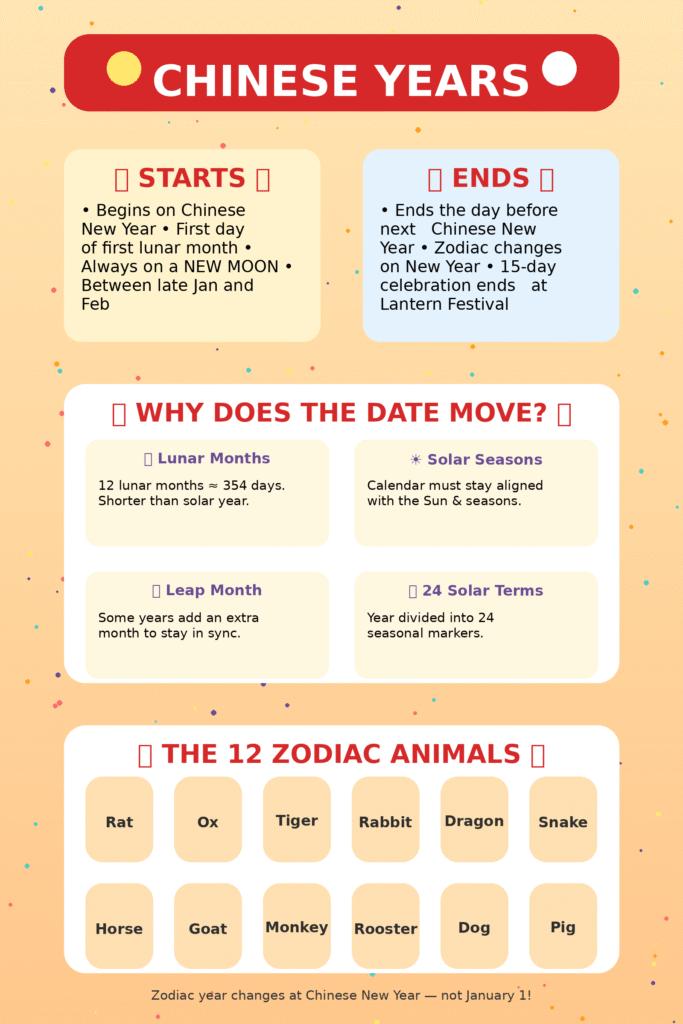
A traditional Chinese (lunisolar) year begins at Chinese New Year, which is the first day of the first lunar month. Chinese New Year always begins on a new moon, and on the Gregorian calendar it falls sometime between January 21 and February 20.
More precisely, the calendar is anchored to the winter solstice: the lunar month that contains the winter solstice is defined as the 11th lunar month. Because of that anchor point, Chinese New Year usually falls on the second new moon after the winter solstice (and only rarely on the third, if a leap month intervenes).
When a Chinese year ends
The Chinese lunisolar year ends the day before the next Chinese New Year—i.e., it runs from one Chinese New Year new moon to the next Chinese New Year new moon.
People sometimes mean the end of the New Year celebration (not the calendar year itself). The festival period is traditionally 15 days: it begins at the new moon (New Year’s Day) and ends at the following full moon, culminating with the Lantern Festival.
Why the start/end dates move each year
The core reason is that the traditional system is lunisolar: it combines lunar months with a solar year.
-
Lunar months don’t fit evenly into a solar year
In the Chinese calendar, months follow the Moon’s phases: months are 29 or 30 days long and begin on the day of a new moon. Twelve lunar months add up to about 354 days, which is about 11 days shorter than the solar year (~365 days). -
Seasons matter, so the calendar must stay aligned with the Sun
If you followed only lunar months, the calendar would drift across the seasons. Traditional Chinese society was strongly agricultural, so the calendar needed to keep months in the “right” seasonal neighborhood for farming, weather patterns, and ritual life. The solution was to keep lunar months, but “correct” them using solar markers. -
Leap months are inserted to keep lunar months aligned with the solar year
To prevent drift, an extra (intercalary) month is inserted in certain years. A commonly stated modern rule (described in several references) is: if there are 13 new moons between one 11th month (the month containing the December solstice) and the next 11th month, then the year has 13 lunar months. In those leap years, at least one lunar month will not contain a principal (major) solar term; that “missing principal term” month becomes the leap month. -
Solar terms provide the seasonal framework
A key feature behind leap-month logic is the system of “solar terms” (jieqi): the Sun’s annual motion is divided into 24 seasonal segments used to track seasonal change. This system links the calendar to climate and agricultural timing across the year.
A short history of “Chinese years”
Early foundations (Shang dynasty and earlier observations)
Evidence from Shang dynasty oracle bone inscriptions indicates that by at least the 14th century BCE, Chinese calendrical practice already tracked the solar year (~365.25 days) and the lunar month (~29.5 days), and used methods that included adding extra months to reconcile lunar months with the solar year.
Development of seasonal structure (late pre-imperial period)
By the 3rd century BCE, the seasonal framework associated with a 24-part meteorological/solar-term cycle was established as part of the evolving calendrical system, strengthening the link between the calendar and seasonal change.
Standardization and reform (Han dynasty, Taichu calendar)
A major milestone came under Emperor Wu of the Han dynasty, who promulgated the Taichu calendar (104 BCE). Britannica describes this reform as reverting to a convention that treated the second lunation after the winter solstice as the first month of the civil year—effectively aligning “the start of the year” with the structure that still underlies Chinese New Year timing.
Modern use
Today, the traditional calendar is used alongside the Gregorian calendar, especially for determining traditional festivals (Chinese New Year, Lantern Festival, etc.) and for zodiac-year naming.
How “Chinese years” connect to the zodiac
Many people mean “Chinese years” as in “Year of the Dragon,” “Year of the Snake,” etc. The Chinese calendar uses a 12-animal cycle attached to years (Rat, Ox, Tiger, Rabbit, Dragon, Snake, Horse, Sheep/Goat, Monkey, Rooster, Dog, Pig). Importantly, the zodiac animal year changes on Chinese New Year, not on January 1.
A practical example of start/end (zodiac-year boundary)
Because the zodiac year begins at Chinese New Year, the Year of the Horse in 2026 begins on February 17, 2026, and the next Chinese New Year in 2027 falls on February 6, 2027—so the Horse year ends on February 5, 2027.
Summary of the “reason for it”
The traditional Chinese year starts at Chinese New Year and ends the day before the next Chinese New Year because the calendar is built around lunar months (new-moon-to-new-moon), but it is also engineered to stay aligned with the solar seasons (crucial for agriculture and seasonal life). That is why Chinese New Year moves on the Gregorian calendar each year, why leap months exist, and why zodiac years do not match January–December.