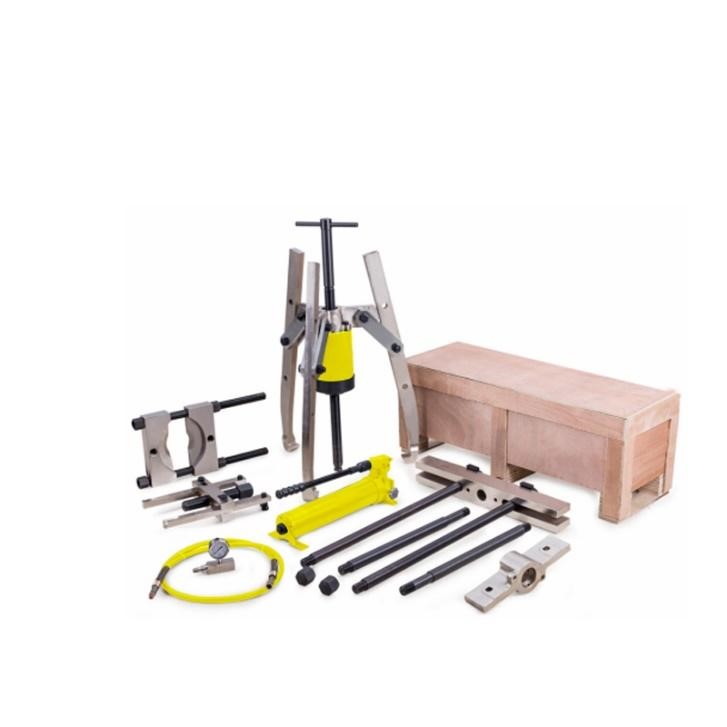
The bearing removal process is carried out using a hydraulic puller. Hydraulic pulling uses a hydraulic jack with a movable mechanical jaw puller. The plunger moves outside whenever the pump is turned on. The mechanical jaws are then positioned underneath the bearing, while the pump is turned on once more.
When a shaft-mounted component needs to be removed, a hydraulic puller is employed. Bearings, pulleys, and gears are examples of shaft-mounted components. The pieces can be rapidly detached without being harmed thanks to the hydraulic power utilized in a puller, which is a significant feature, particularly during repair.
Pullers come in a variety of sizes, and which one to choose depends on the use as well as dimension of the part to be withdrawn. The dimensions of what you need retrieved or pulled aren’t the only factor to consider; the force necessary also performs a role in the extraction procedure, which is determined by the parts’ age, and far too much pressure can damage or shatter the part.
How does it work?
The pump controls the flow of hydraulic fluid through the puller, increasing pressure, pushing the cylinder forward, and finally pressing the puller’s ram. The rams will then be attached to the shaft of the item to be removed. The sort of puller required is determined by the application at hand. The sort of puller to select depends on a variety of factors, including whether it will be used inside or outside. The puller, that has 2 – 3 legs, rotates around the rear or within the part as well as pulls it away from the shaft with the help of a pushing screw positioned against by the shaft’s end.
The jaws of the gear puller must be perpendicular with the screws to provide a straight draw, and the shaft must be connected with the shafts to fit firmly round the item to be withdrawn.
Hydraulic pullers come in a variety of shapes and sizes. When deciding which one is required, a number of factors must be considered in order to select the best puller for the work and ensure that it is accomplished efficiently. Click here to buy the top-quality hydraulic pullers.
What should you know before buying a hydraulic puller?
When selecting a hydraulic puller, there are several aspects to consider:
- Puller reach—you’ll have to know the breadth of the part you’re pulling, as well as the length between the jaw’s pulling surface and the puller’s jaw head. When the jaws expand and close, the space between them changes. The reach must be sufficient to secure the puller and must constantly be equal to or larger than the portion being pulled.
- Hydraulic pullers come in a variety of shapes and sizes. When deciding which one is required, a number of factors must be considered in order to select the best puller for the work and ensure that it is accomplished efficiently.
- The diameter of the item to be pulled determines the puller spread. It is twice as far away between the ram and the jaw’s pulling surface. To connect to the thing being withdrawn, the puller must have enough spread. As the cage goes back, the spread range will widen, and as it moves forward, the spread range will narrow.
- Tonnage is the maximum pulling power that can be safely produced by the puller. The maximal force exerted in tonnes must be seven to 10 times the size of the shaft, which may be estimated by looking at torque curves. For rusty components or where there is a significant area of surface contact, more effort may be required.
Best places to get hydraulic puller
- RIVERLAKE is a combination of the founder’s parents’ hometown names: Sichuan Province (River) and Hubei Province (Lake) (Lake). Taizhou Chuanhu Hydraulic Machinery Co, Ltd. was founded by Tang Lianhua in 2005 as a maker of high-pressure hydraulic tools in China. Hydraulic lifting cylinders, bearing pullers, hydraulic pumps & power packs, flange spreader equipment, hydraulic nut breakers, hydraulic workshop press, hydraulic torque wrench, bolt tensioner instrument, bolt tensioner pump, hydraulic torque wrench power pack, and more are among our major goods. Their goods have been shipped to various nations and locations, including the United States, South Asia, and Africa, due to their high quality as well as professional service. They now manufacture in Yuhuan Longxi Industrial Zone, Zhejiang, at its premises with a total area of 5.000 m2 and 50 people.
- MCGILL HOSE & COUPLING, INC. is a distributor as well as manufacturer of industrial hydraulic hose, both standard and special. Other materials utilised include polyethylene, polypropylene, PTFE, nylon, thermoplastic elastomers (TPE), metal, and others. There are several sizes to choose from. Services include bending, branding, training, fully kitted, pressure testing, inventory control analysis, line management, and leasing. Chemical modification, food as well as beverage, pharmaceutical, construction, petrochemical, electricity production, plastics, transportation, defence, bulk transportation, marine, including public utilities industries are among the industries served. Stock items as well as services are available 24 hours a day, 7 days a week, 365 days a year. ITAR registration is required.