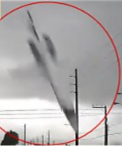
A Learjet traveling from Austin to the Bahamas plunged into a Florida neighborhood after pilots reported icing, turbulence and a rapid loss of altitude. Federal investigators are examining what went wrong.
By The Katy News Staff Editor
November 1, 2026 | National News / Texas News
KATY, TEXAS — A private jet that departed Texas on Sunday morning ended in tragedy hundreds of miles away when it crashed into a residential neighborhood in Palm Beach County, Florida, killing all nine people aboard.
The aircraft, a Learjet 60, departed Austin-Bergstrom International Airport and was headed to North Eleuthera Airport in the Bahamas when its pilots encountered difficult flying conditions shortly before the crash.
According to the Federal Aviation Administration (FAA), the jet crashed at approximately 12:50 p.m. Eastern Time on November 1, 2026, near Cresthaven in Palm Beach County.
The accident has drawn attention across Texas, including the Greater Houston region, as investigators work to understand how an aircraft traveling at cruising altitude entered an extreme descent and struck the ground near homes and a busy roadway.
While there is currently no confirmed connection between the victims and the Katy or Houston communities, the flight’s departure from Texas gives the tragedy particular relevance to residents across the state.
What Happened to the Texas-Departing Aircraft?
The Learjet, identified by registration number N722BD, was manufactured in 2004 and was operating a private flight from Austin to the Bahamas.
Flight-tracking data reviewed by aviation tracking service Flightradar24 shows the aircraft traveling eastward before descending to approximately 35,000 feet over Florida.
The pilots subsequently reported encountering precipitation, icing conditions and moderate turbulence.
Seeking smoother conditions, the crew requested permission from air traffic control to climb to 37,000 feet.
Shortly after receiving instructions to climb, the aircraft began a sharp, uncontrolled-looking descent.
According to Flightradar24’s analysis, the jet entered a steep right-hand descent, with reported vertical descent rates exceeding 32,000 feet per minute.
The aircraft disappeared from tracking systems shortly before crashing.
Investigators have not determined what caused the sudden descent.
Pilots Reported Icing and Turbulence Before Crash
One of the most significant details emerging from the investigation involves the aircraft’s final communications with air traffic controllers.
The pilots reported ice accumulation and turbulence as the Learjet traveled through South Florida airspace.
Aircraft icing occurs when supercooled water droplets freeze on aircraft surfaces, potentially interfering with aerodynamic performance.
Under certain conditions, ice accumulation can reduce lift, increase drag or affect aircraft handling.
Modern business jets are equipped with systems designed to manage icing within approved operating conditions.
However, aircraft performance can still be affected by severe atmospheric conditions, equipment failures or other unexpected circumstances.
The Learjet’s reported icing encounter will likely be examined closely by investigators, along with the aircraft’s maintenance records, weather conditions and flight-control systems.
There is currently no official finding that icing or turbulence caused this crash.
A Descent of More Than 30,000 Feet Per Minute
Flight-tracking records indicate the Learjet descended at an extraordinary rate during its final moments.
To understand the severity, an aircraft descending at 30,000 feet per minute is losing approximately 500 feet of altitude every second.
That is not a typical controlled descent for a passenger-carrying business jet.
The extreme rate raises questions about whether the crew experienced a loss of aircraft control, an aerodynamic problem or another serious emergency.
The pilots also reported an overspeed condition during the descent.
An overspeed condition occurs when an aircraft exceeds an applicable operating speed limit, potentially placing additional stress on its structure and control surfaces.
Investigators will evaluate flight data and physical evidence to understand the relationship between the aircraft’s speed, attitude and loss of altitude.
The Jet Struck Near Homes and a Busy Roadway
The aircraft crashed near Military Trail and 10th Avenue North in Palm Beach County.
Videos from the scene showed the jet plunging toward the ground before erupting into a large fireball.
The impact left a crater and scattered aircraft debris across the surrounding area.
Emergency responders rushed to the scene as firefighters worked to control fires, protect nearby residences and secure the crash site.
Florida Gov. Ron DeSantis confirmed that no injuries or deaths on the ground had been reported during the initial response.
Authorities evacuated approximately 600 residents from a nearby mobile home community while emergency personnel examined the damaged area.
The crash also forced local road closures and disrupted nearby neighborhoods.
Why This Accident Matters to Greater Houston
For residents in Katy, Fulshear, Richmond, Cypress and surrounding Houston-area communities, the crash highlights important questions about aviation safety, particularly during severe weather.
Greater Houston is home to several busy airports serving commercial, private and corporate aviation.
These include George Bush Intercontinental Airport, William P. Hobby Airport, Houston Executive Airport in the Brookshire area and Sugar Land Regional Airport.
Business aviation provides transportation for companies, families and private travelers throughout Texas.
Unlike major airline operations, private aircraft may operate from smaller regional airports and fly routes customized to their passengers’ destinations.
That flexibility makes business aviation an important part of Texas transportation.
The Florida crash does not establish any specific danger involving Houston-area airports or private flights operating in the region. However, the investigation may provide lessons relevant to aircraft operations during adverse weather.
What Can Pilots Learn From This Accident?
Until investigators determine what happened, aviation experts will be cautious about drawing conclusions.
The accident nevertheless raises several important safety questions:
- How did the aircraft’s systems respond to the reported icing conditions?
- Did the crew encounter severe turbulence or rapidly changing weather?
- Were the aircraft’s anti-icing systems operating as intended?
- What caused the sudden increase in descent rate?
- Did the crew experience a flight-control or aerodynamic emergency?
- What information was available to the pilots before the aircraft entered the affected airspace?
These questions will form part of the broader effort to understand what occurred.
What We Know About the Learjet 60
The Learjet 60 is a twin-engine business aircraft produced as part of the Learjet family.
Designed for private and executive transportation, the aircraft is capable of flying at high altitudes and traveling significant distances without refueling.
The aircraft involved in Sunday’s crash was manufactured in 2004, according to aviation tracking records.
Its registration information identifies a Delaware limited liability company as the registered owner.
However, authorities have not confirmed who arranged the flight or identified the passengers and crew publicly.
Investigators will examine the aircraft’s operational history and determine whether any previous maintenance concerns or mechanical issues contributed to the crash.
Federal Investigators Take Over
The National Transportation Safety Board (NTSB) is leading the investigation, with assistance from the FAA.
The NTSB announced that an investigative team would respond to the accident scene.
Investigators are expected to review the aircraft’s wreckage, radar and flight-tracking data, air traffic control communications, weather conditions and maintenance records.
They will also examine any available onboard recordings or other recoverable electronic data.
A preliminary investigation may establish the sequence of events, but determining the probable cause can take months or longer.
Until that process is completed, explanations involving severe weather, icing, mechanical failure or pilot actions remain possibilities rather than confirmed causes.
Nine Lives Lost as Families Await Answers
U.S. Transportation Secretary Sean Duffy confirmed that all nine people aboard the aircraft died.
As of Sunday evening, authorities had not publicly released the identities of the victims.
Their relationship to Texas, if any beyond the aircraft’s departure location, was also unknown.
For the families of those aboard, the crash represents an immense personal loss.
For investigators, it presents a critical question: How did a business jet traveling from Texas toward the Bahamas lose altitude so rapidly that its crew could not recover before impact?
The answers will come from the evidence, not speculation.
The Katy News will continue monitoring the NTSB investigation, the identification of the victims and any developments involving the aircraft’s Texas departure.
Editor’s Note: This story contains preliminary information available on November 1, 2026. Flight-tracking measurements and reported pilot communications are subject to further review. The official cause of the crash has not been determined.