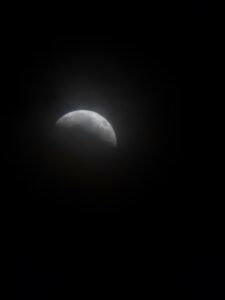
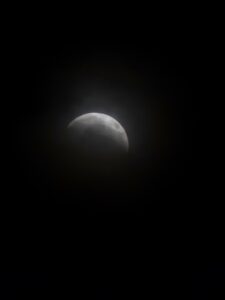
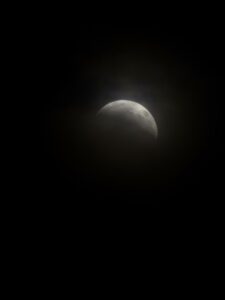
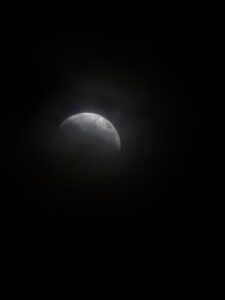
KATY, Texas — Katy-area residents who have been hearing about tonight’s eclipse should know the event visible from our area is a deep partial lunar eclipse, not a solar eclipse. According to NASA, the full moon will pass through Earth’s shadow on the night of Aug. 27 into Aug. 28, creating a dramatic darkening of the moon that will be visible across much of North and South America. Unlike a solar eclipse, this one is safe to watch with the naked eye.
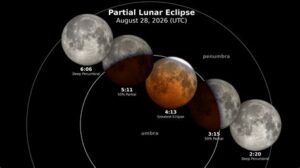
A NASA visualization shows the moon moving through Earth’s shadow during the Aug. 27–28, 2026, deep partial lunar eclipse. The eclipse is expected to reach its maximum at approximately 11:13 p.m. CDT Thursday in Katy. Image credit: NASA’s Scientific Visualization Studio / Science and Technology Corporation / Ernie Wright
For Katy and nearby communities such as Fulshear, Sealy, Houston and Sugar Land, the main viewing window will be late tonight. McDonald Observatory says the moon first dips into Earth’s dark inner shadow at 9:34 p.m. CDT, the eclipse peaks at 11:13 p.m., and the most dramatic part of the event ends about 90 minutes later, putting the best viewing period roughly between 9:30 p.m. and 12:45 a.m. Because these communities are all in the same part of Southeast Texas, residents can use essentially the same timetable for casual viewing.
What should viewers watch for? NASA says that at maximum eclipse, about 93% of the moon’s diameter will be inside Earth’s dark central shadow, called the umbra. That means the moon will not completely disappear, but it can look dramatically darkened with a rusty or copper-colored tint along the shadowed side. If skies stay clear long enough, it should be one of the more impressive moon views of the year for local skywatchers.
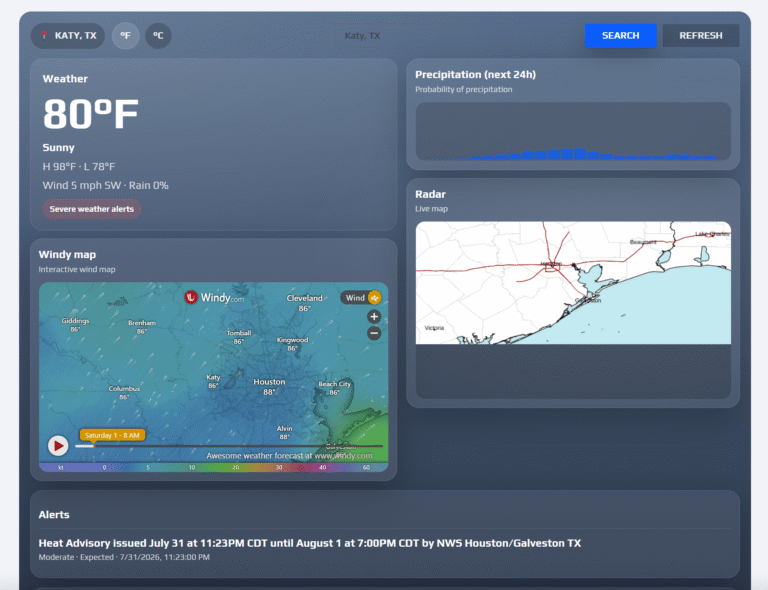
Katy residents may need some patience with the weather. The current forecast for Katy calls for thunderstorms around 10 p.m. and 11 p.m., followed by mostly cloudy skies after midnight. That means cloud breaks could make the difference between a great view and a missed one, so anyone hoping to see the eclipse may want to check the sky several times during the evening instead of giving up early.
The best way to watch is to head outside to an area with a clear view of the sky and as little neighborhood light as possible. No special glasses are needed for a lunar eclipse, but binoculars or a small telescope can make the view even better. For anyone taking photos, a tripod and a steady hand will help, especially near the 11:13 p.m. peak when the moon could take on its deepest color and shadow. NASA notes that lunar eclipses are completely safe to watch directly.
So if the clouds cooperate, tonight could offer a memorable sight for residents in Katy, Fulshear, Sealy, Houston and Sugar Land. The advice is simple: step outside before 9:30 p.m., keep an eye on the moon through late evening, and look up around 11:13 p.m. for the most dramatic part of the eclipse.