
Living trust and estate planning form on a desk.
Trust, and estate law is about how the properties, assets, and other wealth of a person would be dealt with when that person either passes on to death or loses the capacity to make their own decisions. Quite surprisingly, around 55% of Americans don’t have a clear grasp of what trust and estate law is about.
This regulation is important in having some degree of control over how a person’s wealth would be managed when they become incapacitated or distributed when they die. If you want to know what you need to do to start your estate planning or to set up a living trust, you can check the sites of Huber Fox and other trust and estate planning experts.
Meanwhile, here are a few things you should know about trust and estate law:
- Its Importance
You would need to know and understand trust and estate law, so you’ll know what happens to your assets when you become incapacitated or when you die. When either of these two events happens, control over everything you’ve worked for and acquired your entire life will pass on to somebody else. If you want to have a say on how this would be done, then you need to understand how to do your estate planning by understanding a bit of trust and estate law.
Here are some questions which will arise after you die or when you lose the capacity to make decisions for yourself:
- Who will make decisions for your health when you become unable to do it for yourself? – If you lose the mental capacity to decide for yourself, you would want to entrust authority over your health, life, and estate to someone whom you trust.
- Who will inherit your assets? – If you don’t specify who will get what from your estate, this question will be settled for you by the courts when you die.
- How should your creditors be paid? – If you want to determine how creditors would be paid and not let them touch any of the properties which you want to preserve for your heirs, then you also need to include this in your estate planning.
- What will be your legacy? – You can include your passions and advocacies in your estate planning by leaving some money or assets to charities and religious organizations and scholarship grants in educational institutions.
- A Trust Is Different from a Will
Trust isn’t the same as a will. These are two different things. One of the main differences between the two is that a will has to go through a probate court. This means that when you die, your will would have to be presented before a probate court, which will then check whether it’s really your will and whether the things you wrote there can be implemented and enforced in accordance with the law. This also means your heirs would have to spend on court and lawyers’ fees.
By contrast, a trust is a legal tool that transitions your assets to the people whom you want to receive them after your death. This can be done through a collection of legal documents with very little or no court intervention at all. This collection of documents constitutes your trust. A will makes all your assets and finances of public record because everything goes through the probate court. You should consider one if you don’t want other people snooping on your estate.
- A Trust Has to Be in Writing
Trust has to be written in black and white. You can’t set up a trust just by giving verbal instructions on what to do with your assets if you become incapacitated or when you die. When you set up a trust, you’ll have to name a trustee who will manage your assets. You may name a specific person or persons as your successor trustee. But you can also name an entity like a bank as your trustee if you don’t have a specific person to whom you can entrust control over your wealth.
As long as you didn’t make an irrevocable trust, you can still change your living trust whenever you want to as long as you still have the legal capacity. You can even revoke it if you want. When you’ve placed your assets such as real properties, cars, stocks and securities, investments, insurance policies, and all your other wealth into the trust, you can stop worrying about them, knowing that the person you entrusted to be your trustee will implement your instructions.
- What A Trust Contains
A living trust contains four primary components:
- You make an inventory of all your assets and wealth by making a list. You then put in writing who your beneficiaries are. Beneficiaries are the persons who will receive the assets of the trust when you die.
- You specify and name a trustee or trustee who will manage your assets while you’re still alive.
- You give legal power and authority to your trustee and specify your instructions that you expect your trustee to follow and implement.
- You also provide guidelines and details on how you want your trustee to manage your assets while you’re still alive, as well as how to distribute them when you die.
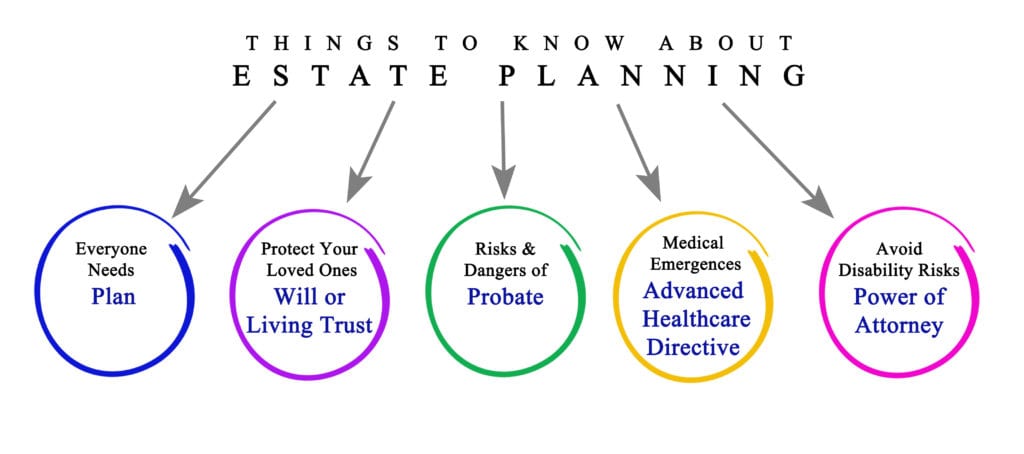
Things to Know About Estate Planning
Entrusting Your Wealth
By now, you would’ve realized that the most important function of trust and estate law is that it deals with entrusting a person’s wealth to the control of another person either while they’re still alive or when they pass away. Since a person’s estate is the sum of their lifelong efforts and industry, they’d surely want to have a say in what happens to it before they go to the afterlife.