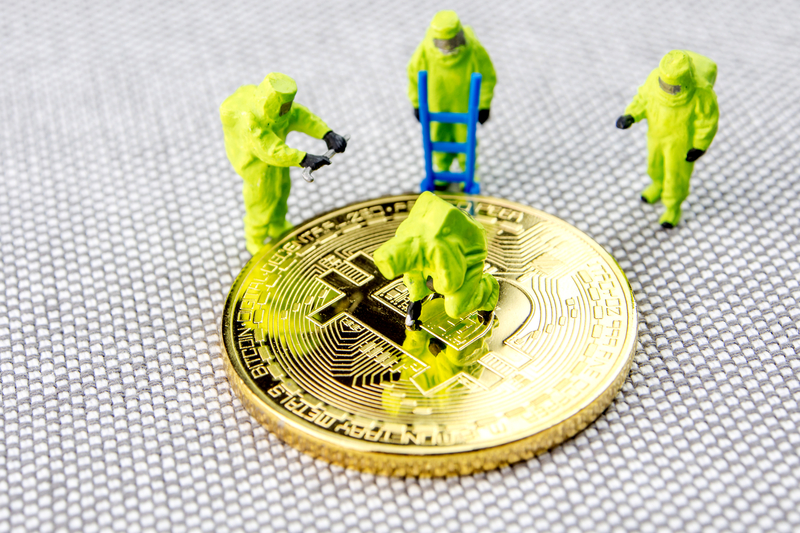
 Most investors have the mindset of venturing into businesses that could guarantee higher returns. It’s the name of the game. Bitcoin mining has drawn interest from many investors since its inception. They get interested in how they could earn from it without losing any assets. Today, it’s a hot topic for new players to understand the system better to their advantage.
Bitcoin mining is not a complex matter to understand. It is a process by which new bitcoins are put into circulation. However, this process is crucial in the maintenance and development of the blockchain ledger that uses sophisticated computers operating to solve highly technical math problems. There are incentives at stake for the miners – and that’s what makes it more rewarding.
Before You Become a Miner, Keep this in Mind
This may sound unpleasant to hear, but crypto mining is painstaking, costly, and the rewards are not guaranteed. Nevertheless, this type of investment appeals to many investors as they can get crypto tokens in return. This is the primary incentive that prospects look forward to, but getting such tokens does not mean you need to be a miner.
Keep in mind that the purpose of mining is to monitor and legitimize bitcoin transactions and to ensure their validity. These processes spread across all users, and the Bitcoin system is decentralized; meaning, it does not have a central authority like government or bank that regulates its operation.
How You Can Mine Bitcoins
If you decide to mine bitcoins, remember that you will get paid for your work as an auditor. You will be verifying the legitimacy of bitcoin transactions so that the integrity of the system could be protected and users can have confidence in the honesty of the players. The verification is also meant to avoid the double-spending problem – a scenario where the bitcoin user spends the same crypto twice.
The process of earning works this way: If you have verified 1MB (megabyte) worth of bitcoin transactions, you are eligible to receive rewards amounting to the number of bitcoins. Note that 1MB is the limit set in this transaction, although some miners appeal to increase it to accommodate more data.
However, here’s the surprising fact: Having verified 1MB worth of transactions and being eligible to earn bitcoin does not automatically mean that all miners will get paid out. Why? Because there are two conditions that should be met to get the rewards:
- You need to verify a certain amount of transactions.
- You have to be the first miner to get the right or closest answer to a numeric problem, also called proof of work. No advanced math is involved because it’s guesswork.
Understanding Mining and Bitcoin Circulation
Incentives and supporting the bitcoin system are not the only purpose of crypto mining. It is also essential in releasing new cryptocurrency into circulation, also called minting. The coins minted through the genesis block will have resulted from the transactions made by miners.
If you’re asking whether bitcoin as a network would still survive without miners, the answer is yes. Bitcoin can still exist and be usable, but no additional bitcoins would enter the crypto circulation. That means bitcoin mining could eventually come to an end if that’s the case.
Due to the fact that the rate of bitcoin mined decreases over time, the final crypto won’t be circulated until about the year 2140. However, it does not mean that verification of transactions will stop. Miners can continue the process and still get incentives essential in keeping the bitcoin network’s integrity.
What You Need to Mine Bitcoins
Sometime in the past, miners had to compete for blocks using their personal computers. Gladly, this is not the case anymore. Changes have been implemented, and volatility of the system is inherent. For the blockchain to function smoothly and process or verify transactions, the bitcoin network needs to produce one block at least every 10 minutes.
As a piece of advice, you need to invest in powerful computers like an application-specific integrated circuit (ASIC) to mine competitively and have an advantage over other miners. It’s worth the investment once you get the returns.
How Much You Can Earn as a Miner
Bitcoin incentives for miners are reduced by half every four years. During the initial mining in 2009, miners of one block would get 50 bitcoins. In 2012, this became 25 bitcoins and 12.5 in 2016. In 2020, it reduced to 6.25 bitcoins, and the bitcoin price was about $17,900 per bitcoin. Meaning, you can earn as much as $111,875 (6.25 x 17,900) for completing a block. This is a good incentive for participating in this challenging yet can be a rewarding venture.
Bitcoin mining is for you if you embrace uncertainty, which is always part of every Monero Benchmarks. Giving it a try would enable you to test your wit and luck in competing for the incentives.